

Sermon Notes and Outlines
Choking Hazards 4-26-26 AM
I. The distractions of the world.
a. The first thing Jesus notes as a choking hazard are the cares of this world.
b. Think about all that is going on around us or in which we are involved.
i. These things are not wrong by themselves are they?
ii. They become wrong when they cause us to turn our attention to them and from God’s word.
c. Our jobs are not wrong are they?
i. We are told that if a man does not work he should not eat (2 Th. 3:10-12).
ii. Working is right and commanded.
iii. How many do we know that have allowed work to take them from God?
d. Sports are not wrong.
i. Paul used multiple athletic illustrations and did so by inspiration.
ii. Wrestling, boxing, and running come to mind.
iii. How many families will miss services to be at an athletic event for their children?
iv. How many children are allowed to miss services for a practice or a game?
e. These things, and others that you may think of, are not sinful.
f. But they can be consuming if we allow them to be.
g. Remember the account of Jesus being in the home of Mary and Martha?
i. Mary was sitting there listening to Jesus.
ii. We know what it says about Martha (Lu. 10:41-42).
iii. Jesus was right there in her house teaching and she was caught up with things, though nice, that were less important.
h. We cannot give in to the temptation to make unimportant things more important than Jesus and His word because that is a choking hazard.
II. The deceitfulness of riches.
a. As we come to this choking hazard, we need to understand that having riches, or wealth, is not sinful.
i. Many of God’s great people have been people of wealth.
ii. Abraham, Job, David all come to mind.
iii. Joseph of Arimathea had wealth.
iv. What is sinful is the love of money (1 Tim. 6:10).
b. We need wealthy Christians to help support the Lord’s work.
c. Problems arise when we allow riches to deceive us.
d. You might say, riches are inanimate, so how can they deceive us?
e. The possession of wealth gives a false feeling of security.
i. In Luke 12, we read of a wealthy man.
ii. This man had a great harvest one year.
iii. Notice how he felt about this (Lu. 12:17-19).
iv. Look how God viewed him (Lu. 12:20).
v. The man’s attitude was “I’m safe because I have enough.”
vi. Many people feel money is the answer to all of life’s problems and if they have it, they cannot be harmed.
vii. Money is fleeting and, as the wise preacher points out, we are going to die and just leave it to someone else (Ecc. 2:17-19).
f. The possession of wealth promises satisfaction.
i. John D. Rockefeller founded Standard Oil and became America’s first billionaire.
ii. He was asked by a reporter, “How much is enough?”
iii. His reply was “Just a little bit more.
iv. In his chase for wealth, Rockefeller had terrible stress, lost his hair early, had digestive issues, and was constantly worried about losing his money.
v. He said later in life, “I have made many millions, but they have brought be no happiness.
vi. Listen to something else the wise preacher said…(Ecc. 5:10).
g. The possession of wealth promises significance.
i. Having money makes many people feel that they matter more than others.
ii. We’ve seen this attitude in many movies and it is made fun of in that sense.
iii. Movies generally point out things that are true in society.
iv. How much wealth we have does not matter in the end (Mk. 8:36).
v. Paul warned about the uncertainty of riches (1 Tim. 6:17).
vi. Money will always meet certain needs, but it will never meet the needs of the soul.
h. We cannot give into the temptation of placing wealth over our soul because that is a choking hazard.
III. The desire for more.
a. In case something was left out, Jesus finished His thought of things that can be choking hazards with “the lust of other things.”
b. This goes deeper than a harmful desire for wealth.
c. It may be a craving for status.
i. Children today do not aspire to be astronauts or ball players nearly as much as they used to.
ii. What many children aspire to be now is known as an influencer.
iii. They want the status that goes along with social media fame.
iv. They want fame, to be known by many.
d. It may be chasing comfort.
i. This usually involves a chase for wealth.
ii. It goes beyond it because it is a great desire for the things that wealth can get you.
iii. The nicer car, the fancier house, the better gadgets or toys.
e. It has to do with wanting more of anything in place of God.
f. 1 John 2:16.
g. It is not what you have that matters, but what has you.
h. I read this very true statement: When desire is disordered, devotion is diminished.
i. Too many allow their possessions to possess them and our Lord says that is a choking hazard.
The Joy Of Forgiveness 4-19-26 AM
I. The blessing of forgiveness (Ps. 32:1-2).
a. The word blessed is the idea of a deep happiness because of a right relationship with God.
i. We see this idea in the very first psalm (Psalm 1:1-2).
ii. We also see this in the beatitudes of our Lord (Matt. 5:1-12).
iii. It is not just being happy, but happiness based on knowing one is in the good graces of God.
b. David describes the way to this state of blessedness in three ways.
c. He first says, blessed is the one whose transgression is forgiven.
i. Transgression is a going beyond the line God has drawn.
ii. Forgiven carries the idea of being lifted up and carried away.
iii. David is saying the blessed, happy person is the one whose rebellion has been removed.
iv. This tells us that God is able to lift and remove the burden of confessed rebellion.
d. Secondly, David wrote that one is blessed when his sin is covered.
i. The idea of the word sin is to miss the mark.
ii. Covered does not mean swept under the rug, but dealt with in such a way that they are totally removed.
iii. This is a picture of God’s mercy – giving us what we do not deserve.
iv. God doesn’t ignore sin – He covers what He forgives.
e. Thirdly, David writes that one is blessed when God does not impute to sin to him.
i. The word iniquity carries the idea of guilt or crookedness.
ii. Impute means to count or charge to one’s account.
iii. Once a person is forgiven, God does not count that sin against him any longer or keep it on his record, or account.
iv. This is the point Paul makes in Romans 4:6-8.
v. Forgiveness means our guilt is no longer counted against us.
f. These three things are a result of the final statement of verse 2.
i. There is no deceit in this blessed person.
ii. It does not say the person is sinless.
iii. This person has been completely honest with God about his sin and opened up to God about it seeking forgiveness.
g. The joy of forgiveness belongs to those who stop hiding their sin and become honest with God about it.
II. The burden of hidden sin (Ps. 32:3-4).
a. Have you ever done something wrong to someone you love or respect but he or she didn’t know about it?
i. How did you feel emotionally around that person?
ii. Where you on edge and upset?
b. What about when you knew you had sin in your life that was coming between you and God?
i. How did you feel, or maybe, how do you feel right now if that is where you are at the moment with God?
ii. Do you feel good about it or is there some sense of being upset?
c. Notice how David feels.
i. One version says “my body wasted away.”
ii. Roaring is translated groaning in some versions.
iii. God’s hand was heavy on him and his strength was dried up.
d. The point is, concealed sin does not bring peace or happiness.
i. There is no feeling of being blessed when we are hiding sin from others.
ii. We aren’t hiding it from God because He knows all.
e. Hidden sin drains us.
i. We dwell on it and have a strong sense of guilt.
ii. If we hold it too long, we can become hardened to our sin (Heb. 3:13).
f. If we have properly trained the conscience, sin hurts us because we understand what it does to our relationship with God (Isa. 59:1-2).
i. David hurt because he knew he was not right with God.
ii. The same is true for us when we try to conceal our sin.
III. The breakthrough of confession (Ps. 32:5).
a. This is the point where Nathan told David, You are the man.
i. David had a decision to make.
ii. He could have Nathan put to death and go on trying to hide or he could confess the sin and make things right.
iii. Being a man after God’s heart, David made his confession.
b. This is the turning point of the psalm.
i. In verse 3-4, David is crushed.
ii. In verse 5, David is changed.
c. David acknowledged his sin.
i. He didn’t try to blame someone else or try to make things look better than they were.
ii. He stopped denying his sin and took ownership of it.
d. This is where repentance starts – relief begins at the same moment honesty does.
e. A lot of our spiritual problems continue because we discuss how we’ve been hurt, we are stressed, our past family problems, or how we’ve been disappointed by others, but we fail to admit we have sinned.
f. Healing only begins when we stop arguing with God about our sin.
g. David then says, my iniquity I have not hid.
i. This is a play on the second idea of verse 1.
ii. Only God can cover or hide sin properly because only He can forgive it.
h. This is a very powerful contrast between us and God.
i. We are terrible saviors.
ii. We cannot hide our sins, only sweep them under the rug.
iii. We can’t bury what God still sees.
i. People use filters and photoshop on social media all the time.
i. They do this make themselves look better.
ii. They try to hide some blemish or remove something out of the picture they don’t like.
j. There is no filter or photoshop for sin – God sees the real thing.
k. Either we can spend our lives trying to cover our sins, or we can bring our sins to God who can truly cover them with forgiveness.
l. As long as David tried to hide his sin, he lived in misery.
m. When he uncovered it before God, God covered it with mercy.
n. We have to stop hiding the sin that only God can heal.
o. David made his confession to the Lord.
i. David didn’t vent about his sin on a Facebook or social media post.
ii. David didn’t confess his sin to a priest or a friend.
iii. David confessed his sin to the only one who could do something about it – the Lord.
p. This is the majesty of grace: when sin is truly confessed, God is eager to forgive.
q. Some people in this room may be living in verses 3-4 right now.
i. The way forward is not hiding and covering sin.
ii. It is not better image management.
iii. The way forward is verse 5.
r. The doorway from misery to mercy is not marked “perfection” – it is marked “confession.”
IV. The benefit of seeking God (Ps. 32:6-7).
a. David has told us what he did about his sin and now begins to tell us what to do with ours.
b. David says “For this” in the KJV and that is “Therefore…” in the ESV.
i. Because of what has just been stated is the idea.
ii. Because God forgives and wants to forgive, sinners should seek Him.
c. David says to seek God now.
i. Don’t wait until sin hardens us.
ii. Don’t wait until our conscience is seared (1 Tim. 4:2).
d. The right time to seek God is when He can be found.
e. This doesn’t mean God is playing hide and seek with us.
i. It is teaching we may not always have the time to seek Him.
ii. Every opportunity to turn to Him should be treated with the utmost seriousness and sincerity.
f. The right time to seek God is right now (2 Co. 6:2).
g. When a person seeks God through repentance and confession, other times of temptation and distress are still going to come – there will be the rush of great waters.
h. When those times come, they don’t have to sweep us away from God.
i. If we have strengthened that relationship with God, we are much more difficult to be moved.
ii. This only comes by continually seeking God and strengthening our relationship with Him.
i. We need to trust God as a hiding place.
j. David had tried hiding his sin, but will now hide himself in God.
k. He had tried hiding from God, but now hides in God.
l. God provides continual care and deliverance.
i. God watches over us as David realized.
ii. David had been surrounded by guilt but now he is surrounded by songs of deliverance.
m. God not only forgives His people, He keeps surrounding them with grace and mercy.
Therefore… 4-12-26 PM
I. Since (Heb. 10:19-21).
a. The writer, by inspiration gives a very brief summary of what believers have in Jesus.
b. We first says, since we have confidence because of the blood of Jesus.
i. The holiest mentioned is the idea of the most holy place in the temple or tabernacle.
ii. This was only entered once a year and only by the high priest.
iii. This was a guarded place.
iv. The ordinary worshiper could not enter boldly into the presence of God on the mercy seat of the temple.
v. Because of the blood of Jesus, each Christian can go into what the most holy place represented – the throne room of God in heaven.
vi. We do this by prayer – we don’t need a high priest to go for us because, in Christ, we can go there ourselves (Heb. 4:16).
vii. This confidence is not in ourselves.
viii. This confidence is because Jesus has shed His blood, opening up this avenue of coming before God for all mankind.
c. He then writes, and since is not provided but implied, since we have a new and living way to go beyond the veil, or curtain.
i. The old way was repeated sacrifices.
ii. The old way was distance between yourself and temple and between yourself and God.
iii. The old way was a constant reminder of your sin.
iv. Jesus opened a new and living way.
v. It is new because it allows us to beyond the curtain of the temple to the very presence of God.
vi. It is new because it is tied to a new covenant.
vii. It is living because it is opened by a living Savior.
viii. It was all provided for by the giving of the flesh of this living, resurrected Savior.
d. Lastly in this point, since we have a high priest over the house of God.
i. Our high priest is Jesus.
ii. He is not only the sacrifice but He is also the High Priest.
iii. The house of God is not just a building, it is the church (1 Tim. 3:15).
e. The Christian life must be led through remembering what we have in Christ.
f. We have access to God because of the blood of Christ.
g. We have a new and living way because of Christ.
h. We have a great High Priest who is the Christ.
i. We cannot and must not leave the One who provides us these things.
II. Let us (Heb. 10:22-25).
a. Since we have all these things, there are some things we need to do.
b. We need to draw near to God (vs. 22).
i. We need to come to God with complete sincerity.
ii. We need to fully give our lives to God.
iii. We need to do these things in complete faith.
iv. Just as a Jew would come to the temple to get close to God, bringing a sacrifice because his faith moved him to believe the promise of God.
v. We must bring ourselves as this living sacrifice as we are taught in Rom. 12:1-2.
vi. We are able to do this because we have been obedient to the gospel by having our hearts cleansed through baptism.
vii. We can’t live at a distance from God.
viii. We must draw near Him through worship, service, and steady fellowship with Him.
c. Let us hold fast our confession (vs. 23).
i. Remember, these people are being tempted and compelled to deny Jesus as the Messiah.
ii. When they obeyed the gospel, they made the good confession, just like we have.
iii. Why did they need to hold fast?
iv. God is faithful that promised.
v. We are not being compelled to go to Judaism, but we are tempted all the time to deny Jesus.
vi. Circumstances will never be easy but we can’t give in.
vii. We can’t give in because God will never fail us.
viii. He has made us great promises.
ix. He is faithful to keep them and we must keep what we’ve committed to Him.
d. Let us stir up one another to love and good works (vs. 24).
i. Things are difficult for all of us, just like they were difficult for 1st century Christians.
ii. The word translated provoke in the KJV is translated stimulate are stir up in newer translations.
iii. It cares the idea of a strong urging of others towards the end of producing more love for one another and good service to God and others.
iv. When the KJV was translated, the word provoke meant to stimulate to action, where it is now a negative word.
v. Instead of abandoning our brethren, we need to stimulate one another to do more for each other and more for God.
vi. When things are difficult, that is the time to lean in harder on doing what is right.
vii. We stimulate one another through various ways.
e. Let us not forsake the worship of God.
i. This let us, like the since in verse 20, is implied.
ii. When we forsake the assembling of ourselves together, we let one another down.
iii. In a sense, the writer is stating, not encourage to assemble, but assemble to encourage.
iv. Our worship services are to build one another up and encourage one another.
v. When we fail to assemble, whether because of pressure not to come or mere neglect, we fail to encourage one another.
vi. We can’t let hardship push us away from the people we are supposed to be encouraging and who will encourage us.
vii. The gathered church is one of God’s avenues of keeping us from drifting.
viii. The truth is, we cannot hold fast to God alone.
f. Since we have such a great Savior, let us do these things mentioned.
III. Fearful (Heb. 10:26-30).
a. This is a very negative section of scripture.
b. It shows what happens to those who leave Jesus.
c. It ought to be frightening to us.
d. This is not about some moment of weakness followed by repentance.
i. This is looking at a willful turning from and leaving Jesus.
ii. This is apostasy.
e. It needs to be understood that we don’t have to leave the church to apostatize.
i. We can live lives of rebellion against the Lord and be at services every time the doors are open.
ii. We can attend all services and still be without a Savior.
f. If we willfully turn from Jesus, whether leaving Him physically and spiritually, or just spiritually, there is no more sacrifice for sins.
i. There is nothing else that will save us.
ii. No one or nothing else is coming to be our sacrifice for sins.
iii. Also, how does one believe in once saved, always saved interpret this passage?
iv. The writer is saying it is very possible to receive the truth and then leave it.
g. The writer describes leaving Jesus in three shocking ways:
i. Trampling underfoot the Son of God.
ii. Profaning the blood of the covenant.
iii. Outraging, doing despite, to the Spirit of Grace.
h. Can you imagine stomping on the face of Jesus and God being okay with that?
i. Can you imagine treating as common the blood of the uncommon Savior and God being okay with that?
j. Can you imagine angering the Holy Spirit, which we do when count His word as nothing, and God being okay with that?
k. When someone treated the law of Moses this way, once two or three witnesses confirmed it, that person was put to death with no mercy.
l. All we will have left is a definite fear of judgment and knowledge of fiery indignation from God.
m. We are viewed as adversaries of God when we leave Him like this.
n. The writer closes this out by quoting two Old Testament passages: Deut. 32:35 and Deut. 32:36.
i. These verses should strike fear in us.
ii. God is not going to miss.
iii. Even those who once belonged to Him.
The Reality Of Salvation 4-12-26 AM
I. The realization of sin (Acts 2:37).
a. The apostles had just stated that God had made Jesus both Lord and Christ and they had crucified Him (Acts 2:36).
b. This message pierced them.
i. They were cut to the heart.
ii. Some versions say pierced to the heart.
iii. One version has the footnote, “Wounded in conscience.”
c. This means that truth wounded them before it healed them.
d. These people were brought face to face with their guilt.
e. In order to be saved, a person must stop arguing with God about sin and start agreeing with Him about it.
f. People have to come to understand two things:
i. How much God hates sin.
ii. They have sin in their lives.
g. Until those two things are realized, individuals will never be saved.
i. The people on Pentecost were religious and devout, which tells us they were aware of the first thing.
ii. It was not until Peter and the apostles pointed out their complicity in the death of Jesus that they became aware of the second.
h. No one comes to Christ or becomes saved casually.
i. There is no such thing as accidental salvation.
ii. Before one can have peace with God, there has to be conviction of sin.
i. These people heard the gospel.
i. They were shown by scripture who Jesus was.
ii. They were shown what they had done in bringing about His death.
iii. They were shown what that meant before God.
j. The word of God exposed their sin to them.
k. Heb. 4:12.
i. Acts 2 contains a vivid illustration of the truth of this verse.
ii. The sermon did not just inform them, it exposed their hearts.
l. When do we usually go to the doctor?
i. Not until the pain becomes too severe to dismiss.
ii. The pain isn’t the cure though, is it?
iii. It is the warning that something is wrong and needs to be seen about.
m. In the same way, conviction of sin is painful, but it is merciful.
i. God is showing us that our condition is serious.
ii. He is showing us that our condition is spiritually deadly.
n. Some people never come to Christ because they are never honest about their sinful state.
i. They compare themselves to others and say, “I’m not that bad.”
ii. It does not matter if we are better or worse that someone else.
iii. It matters only if we are right with God.
o. The prodigal son did not come home until he came to himself (Lu. 15:17).
p. David was not restored until he said, “I have sinned against the Lord” (2 Sam. 12:13).
q. The publican in Luke 18 went home justified only after he cried out “God be merciful to me, a sinner.”
r. No one will seek salvation until there is a realization of sin in one’s life.
II. The requirement for salvation (Acts 2:38).
a. Once the people asked what they needed to do, Peter, by inspiration, gave them a clear answer.
i. He didn’t say, say this prayer.
ii. He didn’t say, you are already saved.
iii. He didn’t say, nothing at all.
b. The requirement was plain: repent and be baptized.
c. Repentance is a change of heart that leads to a change of life.
i. It is a turning away from sin.
ii. But it has to be coupled with a surrender to the rule of Christ.
d. Baptism is not presented as being optional or a good idea.
i. Peter joins it with repentance as the response of faith to the gospel.
ii. When they came to believe who Jesus was, they had to repent and be baptized for the remission of their sins.
e. There is a lot of argument about this in the religious world.
i. And joins things of like value.
ii. The word translated for means to obtain.
iii. It really is this simple.
iv. Repentance and baptism are equal and, when combined, bring about the obtaining of the remission of one’s sins.
f. The book of Acts consistently presents this response as the way people entered Christ.
i. In every conversion account in the book, baptism takes place.
ii. These on Pentecost, those at the temple when Peter and John heal the lame man, Cornelius, Saul who became Paul, the Samaritans in Acts 8, Lydia, and every other account in the book.
g. Jesus said whoever believes and is baptized will be saved (Mk. 16:16).
h. Romans 6:3-4 tells us that in baptism we are united with Christ in His death and raised to walk in newness of life.
i. In 2 Kings 5 we read about Naaman.
i. He wanted to be healed of his leprosy but he was resisting God’s simple command to dip seven times in the Jordan River.
ii. He wanted to be healed on his own terms.
iii. Only when he humbled himself and obeyed exactly what God said was he healed.
j. This is still the struggle today.
i. People are glad and willing to talk about grace in the abstract, but continually resist the form of obedience God has laid out.
ii. Grace does not eliminate our response: it calls for a response.
k. The world says, “Do what you want or what feels right”; the gospel says, “Do what God says.”
l. We can’t rewrite Acts 2:38 to fit our preferences.
m. Peter preached by the authority of Christ and was guided by the Holy Spirit in so doing.
n. We can’t improve on heaven’s answer to this vital question.
o. Repentance means we can’t hold on to the sins we love.
p. Baptism means we can’t keep Jesus at a distance.
q. Both say: “I yield myself to Christ.”
r. Real salvation follows the requirements of God instead of inventing its own.
III. The responsibility of self (Acts 2:40).
a. We don’t have all the words that Peter and the apostles preached on that great day.
b. But we do have this saying recorded in verse 40.
c. There is no way that Peter was saying they had the power to save themselves apart from Jesus.
i. Scripture is clear that Jesus is the only Savior.
ii. His blood is the purchase price of our redemption (Acts 20:28; Rom. 5:8-9).
iii. We will always be saved by God’s grace (Eph. 2:8-9).
d. What Peter did say is that each one present had a personal responsibility to respond to the gospel.
i. No one could obey for them.
ii. Their spouses, parents, children, friends could not respond for them.
iii. No one could surrender their heart for them or anyone else but him or herself.
e. These words scream out personal responsibility.
i. Their generation, like all previous and following ones, was crooked, or sinful.
ii. They did not have to remain a part of it, just like we do not.
iii. They were being called to separate from rebellion and submit to Jesus and we are as well.
f. This fits the pattern of scripture.
i. Noah built the ark, but each person had to enter it.
ii. Moses lifted up the serpent, but each bitten person had to look at it.
iii. Jesus died for all men, but each soul must submit in obedience.
g. No one can eat for you can they?
h. No one can take medicine for you can they?
i. Someone may care deeply about you, plead with you, and pray for you, but that person cannot obey the gospel for you.
i. Parents can raise you to know the truth.
ii. A spouse can encourage you.
iii. A preacher can preach to you.
iv. A congregation can surround you with love and encouragement.
v. No one can obey Jesus in your place.
j. This is where many people stall.
i. They know the truth and may even feel conviction.
ii. They may even intend one day to obey, but they keep waiting for a better time.
k. Felix trembled in Acts 24, but that is not the same thing as transforming.
l. Agrippa was almost persuaded in Acts 26, but almost is still lost.
m. 3,000 people in Acts did not just feel something, they acted.
n. You and I, individually, are responsible for what we do with Jesus.
o. You and I, individually, are responsible for what we do with truth.
p. You and I, individually, are responsible for whether we remain in sin or come to Christ.
q. This passage teaches the responsibility of self.
IV. The reception of the Savior (Acts 2:41).
a. This is the beautiful end of the passage.
i. Those that were in despair did not all stay in it.
ii. The people who asked the question got an answer.
iii. The people who heard the word received it.
b. We know this because they obeyed it.
c. Receiving the word was not just merely nodding and agreeing with the sermon.
i. It was not admiring the apostles preaching.
ii. It was responding in obedient faith.
d. Their receiving the Savior was active, not passive.
i. They welcomed the truth and submitted to it.
ii. Their glad reception showed itself in immediate obedience.
e. The result was wonderful: they were added to the church – the Lord and His people (Acts 2:47).
f. Receiving the Savior at His word was not invisible sentiment or a great feeling.
g. It brought those people into a new life, a new people, a new allegiance, and a new hope.
h. When a person is drowning, he doesn’t argue with the lifeguard.
i. He doesn’t say, “Thanks for the offer, let me think about it for a minute.”
ii. He yields to the rescue.
i. This is what the 3,000 did with Jesus.
j. They did not debate the remedy, they received it.
k. 3,000 people obeyed that day.
i. The gospel can still move large numbers, but it always comes down to individual hearts.
ii. Every one of those 3,000 souls had to receive the word for him or herself.
l. Today, people often want a Savior without surrender.
i. You can’t receive Christ and reject His word.
ii. Luke 6:46.
m. When we truly receive the Savior, He is gladly obeyed.
Jesus, The Zealous 3-29-26 AM
I. Zeal declared by David.
a. Psalm 69:9.
b. In the context of the psalm, David is suffering reproach and opposition.
c. We don’t know the exact circumstances in which David found himself, but part of the reason for the suffering was His devotion to God.
i. His loyalty to God brought trouble into his life.
ii. This shows us that zeal for God is not applauded by the world, and sometimes, possibly not even by our own brethren.
d. There are times that zeal for God brings suffering instead of comfort.
e. David’s zeal was seen throughout his life.
i. 1 Sam. 17:26 – David was upset that Goliath was defying God.
ii. 1 Sam. 17:36 – David said the Philistine would be like the lion and bear he had killed because Goliath had defied God.
iii. 1 Sam. 17:45-46 – David made it clear that the battle was about the name and the honor of God.
iv. David would not and could not sit by while God was being mocked.
f. David’s zeal was seen in worship.
i. David made the plans for the place of God’s worship.
ii. David made the plans for the places of the people in God’s worship.
g. David’s zeal was seen in his longing for God.
i. Ps. 27:4.
ii. Ps. 42:1-2.
iii. Ps. 63:1.
iv. Ps. 84:1-2, 10.
h. David’s zeal was seen in his concern for God’s house.
i. 2 Sam. 7:1-2 – David didn’t understand why he lived in a nice house while God’s ark remained in a tent.
ii. 1 Chr. 29:2-3 – David gave sacrificially for the temple because He loved God.
i. David’s zeal was not merely emotional.
i. It affected what grieved him.
ii. It affected what delighted him.
iii. It affected what he defended.
iv. It affected what he gave.
j. Think about that practically from David’s life.
i. He ran toward Goliath when others cowered in fear.
ii. He rejoiced openly before the Lord while others mocked him.
iii. He longed for God, even when he was on the run from Saul.
iv. He gave generously for what would honor God.
k. David’s statement in Ps. 69:9 was a personal confession of great devotion to God’s honor, worship, and dwelling.
l. Zeal for God means caring deeply about what bears God’s name and refusing indifference when God is dishonored.
m. Zeal for God changes what you defend, desire, and devote yourself to.
n. David declared his zeal for God but his zeal was still imperfect.
II. Zeal displayed in Jesus.
a. John 2:13-17.
i. Jesus entered the temple and found abuse taking place.
ii. He saw God being dishonored and people being taken advantage of by those who said they loved God.
iii. This drove Jesus to show righteous indignation by creating a whip of cords, drive out the moneychangers and overturn the tables.
iv. John 2:16-17.
v. This caused His disciples to remember Psalm 69:9.
b. This shows that the fullest fulfillment of this verse is in Jesus.
c. Why did Jesus cleanse the temple?
i. It was being used in a way that dishonored God.
ii. It was meant to be sacred and was being treated as common.
iii. Worship had been corrupted by greed and irreverence.
d. What exactly was wrong?
i. They had made it a house of trade, or merchandise (John 2:16).
ii. Later, we read that Jesus says the had made it a den of thieves (Mk. 11:15-17).
e. It was not the activity that was wrong, it was the corruption.
f. It was not the convenience but the commercialization of what was holy.
g. Why were these things wrong?
i. They had turned worship into a money-making scheme.
ii. They distracted from the true purpose of the temple.
iii. They dishonored the Father whose house it was.
iv. It is very likely they were hindering those seeking God, especially those in the outer court area associated with the Gentiles.
h. Jesus cleansing the temple was not sinful rage.
i. It was holy zeal.
ii. It was righteous concern for the honor of God.
iii. It was over for the Father expressed in action.
i. This type zeal was seen in other places in the life of Jesus.
i. Luke 2:49 – as a child.
ii. John 4:34.
iii. John 5:19, 30 – Jesus was committed to doing only what pleased the Father.
iv. John 6:38.
v. John 8:29.
vi. Luke 22:42 – Jesus finished the work the Father gave Him to do.
j. Jesus did not just feel strongly about God’s will: He obeyed it, defended it, suffered for it, and fulfilled it.
k. John applies Ps. 69:9 to Jesus because Jesus perfectly embodied consuming devotion to the Father’s honor.
l. True zeal is not measured by personality, volume, or intensity, but by obedience to God’s will even at a cost.
m. David had zeal, but Jesus is the Zealous One.
n. David cared for the Father’s house, but Jesus cleansed it.
o. David suffered reproach for God, but Jesus went all the way to the cross in obedience to the Father.
III. Zeal demanded of Christians.
a. We don’t have the example of Jesus given to us merely for admiration.
b. It is also given for imitation.
c. You and I are to be zealous people.
i. Newer versions have “Do not be slothful in zeal…” to begin Romans 12:11.
ii. Titus 2:14.
iii. Gal. 4:18.
iv. 1 Cor. 15:58.
d. We need zeal in the Lord’s church today.
i. Zeal in worship.
ii. Zeal in prayer.
iii. Zeal in sanctification.
iv. Zeal in evangelism.
v. Zeal in repentance.
e. It has to be proper, biblical zeal, not misplaced zeal.
i. Rom. 10:2, Gal. 1:13-14 and Php. 3:6 were mentioned in the introduction.
ii. Jam. 3:14-16.
iii. Two of the apostles were zealous of a special place by Jesus, which caused problems (Mk. 10:35-41).
f. There are two dangers here: lacking zeal and misplaced zeal.
g. Lukewarmness is condemned.
i. Rev. 3:15-16.
ii. A cold, indifferent, passive Christianity is not acceptable to Jesus.
h. Misplaced zeal is also dangerous.
i. Passion without truth can be destructive.
ii. Energy without knowledge can be harmful.
iii. Sincerity alone is not enough – Paul was sincere while persecuting the church (Ac. 23:1).
i. How do we grow proper zeal today?
i. We have to keep Jesus at the center.
1. Real, true zeal grows when we look at the obedience and devotion of Jesus.
2. If we have a cold heart, it will be warmed by seeing Jesus clearly.
ii. We must anchor our zeal in truth.
1. Zeal has to be governed by scripture.
2. 2 Tim. 2:15.
iii. We have to connect our zeal to obedience.
1. Real zeal is not loud talk.
2. It shows up in faithful living.
iv. We have to guard against those things that kill zeal.
1. Sin.
2. Worldliness.
3. Prayerlessness.
4. Constant distraction.
v. Christians have to stir up one another.
1. Heb. 10:24-25.
2. Zeal is strengthened by faithful fellowship.
j. How do we do these things?
i. Show zeal in worship by coming prepared and attentive.
ii. Show zeal in prayer by setting aside consistent time with God.
iii. Show zeal in study by reading the Bible daily and seriously.
iv. Show zeal in purity by removing what feeds our temptation.
v. Show zeal in good works by looking for others to serve.
vi. Show zeal in evangelism by choosing to speak to others about Jesus.
vii. Show zeal in repentance by dealing with sin quickly.
k. The New Testament calls over and over for believers to have fervent, informed, obedient zeal.
l. Christian zeal is holy passion shaped by truth and shown in obedience.
The Once For All Sacrifice Of Christ 3-22-26 PM
I. The inadequacy of animal sacrifices (Hebrew 10:1-6).
a. Our writer starts this section off by telling us that the law only contained a shadow of the good things to come from God.
i. A shadow is the form without substance.
ii. In fact, our writer then says the law did not contain the very image, Greek word icon, of those good things.
b. This was one of the purposes of the old law, to show the form of what was to come in Christ.
c. Because the law did not contain the substance of those good things, it was impossible for it and the sacrifices made along with it to ever make the followers of it perfect.
i. Notice Hebrews 7:19.
ii. This gives us an idea of what perfect or perfection means in Hebrews.
iii. It is the ability to draw near to God.
d. Those sacrifices under the old law, though demanded, still did not allow the one offering the sacrifice access to God; you still had to go through the high priest.
e. If they could have, as verse 2 points out, then they would not have needed to be continually offered.
i. There was no purging or cleansing from sin under the old law.
ii. Instead, there was a remembrance of sin every time that a sacrifice was made.
f. The reason for this is that it is impossible for animal blood to take away sins.
g. The writer then does something interesting by quoting from Psalm 40:6-8.
h. We will get deeper into this in the next point but something needs to be brought out here that goes along with the inadequacy of the animal sacrifices.
i. Notice that it tells us that God does not want sacrifice and offering and that burnt offerings and sacrifices for sin give God no pleasure.
ii. The animal sacrifices did not bring pleasure to God for this reason: the offerings were a reminder of sin and God hates sin and many of the offerings were made out of ritualistic habit and not love for God.
i. Do you remember what Samuel told Saul, recorded in 1 Samuel 15:22?
j. Remember what David wrote in the penitential Psalm 51:16?
k. God wanted love out of a pure heart and the sacrificial system had devolved into ritualism and all external actions with no change in the hearts of most who offered them.
l. So the animal sacrifices were inadequate because they couldn’t bring full access to God, the couldn’t remove sin, and they couldn’t change the heart of those that came to offer them.
II. The dedication of Christ (Hebrews 10:5-10).
a. Since the animal sacrifices were completely inadequate to remove sin, there had to be a sacrifice made that could.
b. Animal blood was not powerful enough to do it, so it had to be the blood of a human like us, the ones who needed the sacrifice.
c. Hopefully we understand that the sacrifice needed was not a mere human because we are sinful and in need of a sacrifice.
d. It had to be a perfect man and there are none here on earth.
e. For that reason, Jesus, the 2nd Person of the Godhead, became our offering.
i. It took great dedication on His part to become our offering.
ii. It involved giving up His equality with the Father and becoming like us and that took dedication.
f. We mentioned that the writer was inspired to take a quotation from Psalm 40:6-8.
i. If you read the Psalm, for this to be said strictly about David does not make sense.
ii. The entire Psalm is not a look to the Messiah because of verse 12 (Psalm 40:12).
iii. The Psalm overall, is about the trials of life and the need to depend on God’s guidance through those trials.
iv. You see, where David, really all of us, failed in following God, Jesus succeeded.
v. Those things for which David, and us, strive for with God, Jesus achieved.
g. Notice that Jesus is saying that God prepared Him a body.
i. In the original Hebrew of the Psalm, it literally says, “Mine ear thou hast digged”.
ii. The idea is that the body was made by God, showing the Virgin birth - no man was needed, only a womb to bring it into existence because God formed it.
iii. Also, by using the ear in the original, it shows the willingness to hear God’s commands on the part of the One formed.
iv. Jesus was going to hear and heed the commands of the One who formed Him.
h. God was pleased with Jesus, not the burnt offerings and sacrifices.
i. So, he says in verse 7, I come to do thy will O God.
j. Notice now the parenthetical phrase, “in the volume of the book it is written of me”.
i. The Jews had no excuse for not believing in Jesus as the Messiah because the whole Old Testament pointed to Him.
ii. As Jesus had taught the Jews, the Old Testament testified of Jesus throughout it.
k. Since God was not pleased with the offerings of the Old Testament for the reasons we mentioned, Jesus took those away and the law the taught them and brought in the second.
i. But notice how it is stated.
ii. The sacrifices and burnt offerings were not pleasing to God in verse 8.
iii. Jesus came to do God’s will in verse 9.
iv. This tells us that it was God’s will and intention for the first to be removed and the second to be established.
v. There was never a plan for the Old Testament law to continue.
l. It was God’s will to provide for the forgiveness of our sins, to be able to set us apart, our sanctification (vs 10).
m. This was accomplished by the sacrifice of the body of Jesus one time for all time.
n. Notice through all of this that Jesus was dedicated to doing the will of God which culminated in His offering Himself for our sins one time for all time.
III. The ability of Christ’s sacrifice (Hebrews 10:11-18).
a. The writer goes back to the imagery of the old sacrificial system.
i. He points out that those priests continually stood offering the same sacrifices.
ii. The way its written shows the continual offering of the same sacrifices over and over again.
iii. Think about the offerings that were made: every day there were two bulls offered, every new moon their were offerings, every feast had certain offerings, and every time someone sinned there was to be an offering.
iv. All those offerings and the writer tells us that they never took away the first sin.
v. Instead, the high priest was always standing and offering.
b. He then points out that Jesus made one offering for sins forever and is now sitting at God’s right hand.
i. He is such a better High Priest because He offered a better sacrifice: Himself.
ii. This showed He completed the will of God when it came to the need for a sacrifice.
iii. This showed that Jesus was victorious over sin and death and will reign till those two are gone.
iv. Jesus destroyed the power of them with His offering and one day, when He returns, they will be gone forever.
c. Jesus, according to verse 14, only had to make one offering to give us access to God.
d. The writer now quotes again from Jeremiah 31:31-34.
i. This shows again that God never intended for the old law to remain in force.
ii. He doesn’t quote all of it, only that part having to do with forgiveness.
iii. The new law would provide forgiveness and redemption and the forgetting of sin, not a reminder of it.
e. He closes this section letting his readers know that since there is remission of sins, there is no longer a need for an offering for sin.
i. The need was taken care of by Christ.
ii. The one time offering of Himself is good for all time when it comes to the providing of the forgiveness of sins.
Jesus, The Betrayed 3-22-26 AM
I. Dear friend’s disloyalty.
a. Did you notice how the psalmist described his betrayer?
i. Mine own familiar friend.
ii. Newer versions have “my own close friend.”
b. The phrase “familiar friend” comes from the Hebrew term for peace.
i. This was a person in whom David had found peace.
ii. There was a closeness there that went beyond mere friendship.
c. He then says, “in whom I trusted.”
i. David had listened to this person and learned from him.
ii. David trusted the counsel he had given him.
d. David went on to say this man “did eat of my bread.”
i. To sit at a meal with a person in that day indicated closeness.
ii. Not only that, not everyone got to sit at the king’s table.
iii. Only those close to the king were trusted enough to have that honor.
e. The phrase “has lifted up his heel against me” pictures a horse that kicks at its owner.
f. What we see is a picture of great betrayal.
g. We don’t know for sure, but this picture of a betrayer fits that of David’s friend Ahithophel.
i. We know about David’s sin with Bathsheba.
ii. We also probably remember that part of the punishment was the child from that illicit encounter was going to die.
iii. Do you remember the other part of the punishment (2 Sam. 12:10-11)?
h. The fulfillment of this is recorded in 2 Samuel 15-17, where we read about Absalom’s rebellion against David.
i. We first read the name of Ahithophel in 2 Sam. 15:12.
ii. We then read where David is told that Ahithophel is with Absalom and listen to what David says (2 Sam. 15:31).
iii. Why would David pray that prayer?
iv. The answer is in 2 Sam. 16:23.
i. Ahithophel had been a counselor to David it seems.
i. He had given counsel so often and so well, he had obtained a tremendous amount of respect.
ii. We are never told why, but Ahithophel turned against David and went with Absalom into rebellion against David.
j. This is the force of the phrase “has lifted up his heel against me.”
k. The one who had been at peace at the table has now become the one in rebellion.
l. What we learn from this is that some of life’s biggest heartaches do not come from strangers, but from those who are nearest to us.
i. This is why betrayal feels different than opposition.
ii. Opposition comes from outside while betrayal comes from the inside.
iii. We don’t see it coming like we can opposition.
m. Faithfulness to God does not exempt us from relational pain.
i. We can walk with God and still be hurt by those closest to us.
ii. It may be a spouse or a child.
iii. It may be a fellow preacher, elder, or Christian.
n. Nearness is not the same as loyalty.
o. A man can sit at the king’s table and still have rebellion in his heart.
p. Psalm 41:9 is bigger than David though.
q. David’s pain points beyond itself to a greater King who would be betrayed at the table.
II. Disciple’s disloyalty.
a. John 13:18.
b. Jesus expressly and plainly quotes our passage from Psalm 41.
i. He applies it to Himself and His being betrayed by one right there at the table with Him.
ii. Jesus is telling us that David’s betrayal long ago was not just an isolated moment in Israel’s history.
iii. It was a moment that was truly pointing to a much greater betrayal.
c. David was a betrayed king.
d. Jesus is the betrayed King of kings.
e. It is amazing to think that Judas walked with Jesus for three years.
i. He saw many of the miracles.
ii. He heard much of the teaching.
iii. He had spent time with the group.
iv. He was present at the table.
f. I believe that may be the very point of Jesus quoting Psalm 41:9 here – the betrayal comes from one who shared the meal.
g. Judas is close enough to hear Jesus, to eat with Jesus, to be counted among the disciples, yet far enough away in his heart to hand Jesus over to the mob.
h. This is makes the betrayal so shocking.
i. It would be understandable if someone Jesus did not know found where He was and then brought soldiers to arrest Jesus.
ii. Judas is familiar.
iii. He looks like a disciple.
iv. He walks with the disciples.
v. He is in the midst of the disciples.
i. But his heart belongs to someone else.
j. Nearness to Jesus is not the same as devotion to Jesus.
i. We can be around truth but still resist it.
ii. We can do holy things but still love unholy things.
iii. We can sit among people of God and still be spiritually false.
k. Judas is a warning to all Christians who assume that closeness to religious activity equals faithfulness to Christ.
l. We can sit near Jesus and still sell Him out.
m. We may know the songs, the sermons, the prayer language or whatever.
i. We can know when to stand, when to sing, when to say amen, when to bow our heads.
ii. Religious knowledge and familiarity is not saving faith.
n. Judas had exposure to Jesus.
i. Judas had opportunities with Jesus.
ii. Judas had access to Jesus.
iii. But, Judas never surrendered his heart to Jesus.
o. The great issue is not, “Am I around Jesus,” but is “Am I submitted to Jesus?”
p. Judas had what many people assume is enough: information, association, and participation. None of those things can replace devotion.”
q. A person can stand in a garage all day and never become a car; just like a person can sit in church every week and still not be surrendered to Jesus.
r. The seed of betrayal did not die out with ancient counselors or false disciples and that leads us to our last point.
III. Daily disloyalty.
a. Titus 1:16.
b. Luke 6:46.
c. Our mouths can speak loyalty while our lives are led in betrayal.
d. When we excuse sin, protect sin, justify sin, hide sin, or cling to sin, we are doing more than just breaking a rule.
i. We are being traitors to a King.
ii. We are betraying the One who loves us and died for us.
e. Sin isn’t just a failure, it is personal, against God, and a betrayal of Jesus.
f. We may never betray Jesus with silver in our hand.
g. We can betray Him with lust in our hearts.
i. With pride in our hearts.
ii. With dishonesty or cussing in our speech.
iii. With bitterness or hatred in our souls.
iv. With hypocrisy in our worship.
v. With half-hearted obedience in our daily lives.
h. Sin can kiss Jesus and still deny Him.
i. This is exactly what Judas did in the garden.
ii. It looked like affection, but it was pure treachery and betrayal.
iii. We can say Lord with our lips while our lives are saying something else.
i. We need to ask ourselves some questions:
i. What sin am I protecting right now?
ii. What area of obedience am I resisting right now?
iii. Where am I close to Jesus publicly but betraying Him privately?
j. What happens in sermons like this is that, usually, the most faithful among us respond to the invitation, while those of us who are weak sit still.
k. I am not saying these things to drive the faithful to the front.
l. I am saying these things to drive those of us who are weak to repentance.
m. Ahithophel gives us the pattern.
n. Judas gives us the fulfillment.
o. Our own sins show the ongoing danger.
p. The truth is: public devotion can hide private disloyalty.
q. A wedding ring on the hand does not guarantee faithfulness in the heart.
i. Symbols matter but they cannot be a substitute for loyalty.
ii. The Bible in the hand, a song on the lips, or a seat in the pew on Sunday cannot substitute for a surrendered life.
Jesus, The Chief Cornerstone 4-15-26 AM
I. Rejected by nations, but chosen by God.
a. In its context, Psalm 118 is part of a series of psalms that began in 113 as songs of deliverance.
b. Notice how the psalm begins and ends (Ps. 118:1, 29).
i. Israel has been surrounded, opposed and pressed hard.
ii. Despite all that, God had rescued Israel.
iii. This was probably written sometime after the return from exile.
c. This psalm is shows Israel as the rejected stone.
d. The nations looked at Israel and saw a weak, small, vulnerable nation.
e. God did not see it that way.
i. The nations saw insignificance – God saw His covenant people.
ii. The nations saw weakness – God saw His people as a means to display His glory.
iii. The nations saw something easy to pass by – God saw something He had chosen.
f. This is the story of Israel from the beginning.
i. Always rejected by others but chosen by God.
ii. De. 7:7-8.
g. Psalm 118 shows us that what the world rejects may be very precious in the eyes of God.
h. Psalm 118 describes conflict, pressure, and rescue.
i. The Psalmist says they were surrounded by their enemies (vs. 10-12).
ii. They were pushed hard (vs. 13).
iii. Yet, they were upheld by the Lord.
iv. Then comes the great reversal of fortune in verse 22: the rejected stone becomes the cornerstone.
v. Verse 23 tells us this was the Lord’s doing and caused in awe in the eyes of His people.
i. For us today, this matters because we are still tempted to value things by the way the world values them.
i. We can believe that being applauded means being right.
ii. Which in turn leads us to believe that being rejected means being wrong.
iii. God’s word teaches otherwise.
j. Jesus told His disciples that the rejection of the world leads to acceptance by the Father (Matt. 5:10-12).
i. This goes against everything the world teaches.
ii. We are to go for the loudest cheers and the greatest ovations.
iii. God says that is not so.
k. Faithfulness may look small or worthless to the world, but it is precious to God.
l. Obedience may be unpopular and still be exactly where God’s favor is found.
m. David, in 1 Samuel 16, is a fitting illustration.
i. Samuel was sent to anoint one of Jesse’s sons.
ii. David was not the obvious choice.
iii. His own father left him with the sheep so the other sons could come.
iv. Remember what God told Samuel (1 Sam. 16:7)?
v. David was overlooked by men, but chosen by God.
n. This is what Psalm 118 is celebrating.
o. Israel’s story was not meant to end with Israel.
p. It only points forward to the true and greater rejected Stone.
II. Raised by God, but rejected by the builders.
a. Jesus took this passage and applied it to Himself (Matt. 21:33-46).
i. Beginning in verse 33, there is recorded the parable of the wicked servants, or tenants.
ii. Matthew 21:33-41.
iii. Jesus then asks the Jewish leaders what the owner will do.
iv. The Jewish leaders knew exactly what the owner would do.
v. Jesus then applies the parable using Psalm 118:22-23 (Matt. 21:42).
b. In that moment, Jesus identifies Himself as the rejected Stone.
i. The religious leaders knew exactly at whom Jesus was pointing (Matt. 21:45).
ii. They had been entrusted with the stewardship of God’s people, but were rejecting the very Son sent by the Father.
c. This point is not simply that Jesus was rejected.
d. The point is that the rejection of Jesus is part of the very pattern Psalm 118 had already announced.
e. In this sense, Israel was a type of Christ – Israel’s rejection by the nations pointed to the future rejection of Jesus by His own people.
f. The cross was man’s verdict – the resurrection was God’s verdict.
g. The leaders cast out Jesus – the Father raised up Jesus.
h. The builders rejected the Stone – the Father made Him the Cornerstone.
i. An extremely important thing to understand here is that we will never truly know Jesus if we only listen to the crowd.
i. Human opinion is not the final authority on Christ.
ii. The people who should have clearly recognized Him rejected Him most violently.
j. The Stone men rejected is the Savior God raised.
k. This parable is a warning to us today.
i. The tenants thought they could keep control if the Son was out of the way.
ii. Instead, their rejection exposed their rebellion and brought judgment.
l. The warning is clear: rejecting the Son never removes His authority.
m. When we see Jesus as the rejected and raised Stone, we are forced to answer a very personal question: What does that mean for those who come to Him?
III. Relied on by the church to be built together on Him.
a. Peter gives us a beautiful answer to this personal question in 1 Peter 2:4-5.
b. Did you see the same pattern as Psalm 118?
i. Jesus is rejected by men, but chosen and precious in the sight of God.
ii. This is Psalm 118 fulfilled in Christ.
c. Peter adds something very important to this.
i. As we come to Christ, we ourselves are being built together.
ii. Jesus is not just the cornerstone; He is the One around Whom the whole spiritual house is formed.
iii. The church is not a collection of isolated rocks lying near each other.
iv. The church is the spiritual house being built together around Christ.
d. Christianity is not merely personal, but also corporate.
i. We are not lone wolves leaning on Jesus.
ii. We come to Him and are added to His people (Acts 2:47).
iii. We are built together because we are built on Jesus.
e. Herein lies an extremely important lesson we need to make sure we learn and pass on to others.
f. What is important to remember is that the cornerstone does not adjust to the stones that are added to it: the stones are aligned to the cornerstone.
i. We don’t reshape Christ around our preferences.
ii. We align ourselves to Him.
g. His truth sets the line; His character sets the pattern; His gospel sets the center.
h. When we align ourselves to Him, we are not only strengthened individually, we are fitted together as His people.
i. In 1 Peter 2:4-5, Christ is the living Stone, rejected by men, but chosen by God.
i. Believers are living stones because we share in His life and are joined to Him.
ii. Together, we are being built into a spiritual house.
j. Peter’s point is that the identity, unity, and worship of the church all depend on Christ.
k. What this means for each of us is that we cannot build a stable life apart from Jesus and we can’t build a healthy congregation apart from Jesus.
l. We must build our beliefs, our families, our hope, and our place in His church on Jesus and Him alone.
m. Since we are being built together, this also means we need one another.
i. Again, there are no lone wolves and Jesus.
ii. It is Jesus forming a people, a spiritual house, with every stone set in relation to Hm.
n. When we rely on Jesus, He builds us together.
o. Jesus closed the Sermon on the Mount with this idea of building on the right foundation didn’t he? (Matt. 7:24-27).
p. Coming to Christ is what turns scattered lives into a spiritual house.
Dedication Of The Sanctuary 3-8-26 PM
I. The dedication of the old sanctuary (Hebrews 9:18-21).
A. Our writer begins by pointing out the fact that the old sanctuary had been dedicated with blood.
1. Moses had read all of God’s law to the people.
2. When he had read it all, he took the blood of animals, along with water and hyssop and wool, and sprinkled the tablet of stone and the people.
3. This was done to show that they were dedicated to God.
B. He told them this was the blood of the covenant, the blood shed to ratify or dedicate them to God, which brought them into a covenant relationship with God.
1. Notice the similarity of this to what Jesus said in the institution of the Lord’s Supper.
2. Matthew 26:28.
C. Later, when the tabernacle and the instruments used in the worship of the tabernacle were finished, these were all sprinkled with blood as well.
D. This blood cleansed those things in order for them to be used in service to God.
E. This was all done to show to the people the necessity of sacrifice and the cost of sin.
1. God had told them several times that life was in the blood.
2. For things to be dedicated with blood showed to all involved that was being dedicated was costly and important.
II. The disarming of an argument (Hebrews 9:21).
A. Our writer reminds his audience that nearly everything under the old law was purged, or cleansed with blood.
B. There were very few things that blood was not required for in order to cleanse it.
1. Those things that were had to be washed with water or burned in a fire.
2. None of the things mentioned in the Old Law that did not require blood had to do with sin.
3. There was not a sin under the Old Law that did not require blood.
C. Our writer then reminds his audience that without blood there can be no remission.
1. The idea is that it is impossible for their to be the removal of sins without the shedding of blood.
2. A sinner could not and cannot be separated from his sins unless blood has been shed for them.
D. The argument being dealt with is that of the fact the Jews could not understand how the Christ could die on a cross.
1. Numerous times in the New Testament we are told that the death of Jesus was a stumbling block to the Jews.
2. They couldn’t get over the fact that the Messiah died.
E. We know this was because they were thinking physically.
F. Nevertheless, it was a great burden on their mind.
G. The writer, by inspiration, is letting them know that if blood was not shed, there could be no remission of their sins.
1. He’s already let them know that the blood of animals purified the flesh and that was all (vs. 13).
2. It took the blood of Jesus to obtain eternal redemption for mankind (vs. 12).
H. Jesus had to die because blood had to be shed in order for sins to be remitted.
I. It took the Christ, the Messiah, dying for that blood to be shed because animal blood didn’t do the job and the blood of some sinful man would not either.
III. The determination of the purification (Hebrews 9:23-24).
A. Our writer tells us that it was necessary or determined that there had to be purification.
B. The things of the Old Testament were all anti-types of things to come under the New Testament.
1. The Old Testament instruments, sanctuary, and other things were all determined to need dedication and purification.
2. Since they all pointed to things in heaven, under the spiritual nature of the New Testament, the New Testament sanctuary needed purifying as well.
C. This was done with better sacrifices, namely the one sacrifice of Jesus.
D. Jesus didn’t enter a man-made holy place, which were figures or types of what was to come.
E. Instead, He entered into heaven itself and is appearing before the very face of God for us.
1. The word presence means before the face.
2. Jesus is there before the face of God and is there working for us.
3. He is our Advocate, Mediator and Friend before God.
IV. The duration of the sacrifice (Hebrews 9:25-28).
A. Every year the high priest would enter the most holy place with an offering for himself and for the people.
B. We mentioned that he had done this on earth over 1500 times.
C. Jesus didn’t have to do that or else He would have had to have done it forever.
1. Now, one time for all time, Jesus offered Himself.
2. He did so at the completion of the age.
3. This means we are in the last days.
4. There is no other sacrifice coming.
D. You and I are all going to die and then face the judgment.
E. That is what is left after this age, nothing more.
F. Like we die once, Christ was offered once for sins.
1. We don’t die over and over again.
2. Jesus is not offered over and over again.
G. Instead, those who have died to sin are looking for Jesus to come again, not to deal with sin, but to take us home.
H. The ESV, at the end of verse 28 says, “not to deal with sin but to save those who are eagerly waiting for him.”
1. Jesus has dealt with sin by the sacrifice of Himself.
2. That sacrifice endures until time is no more.
3. He is coming back to save those of us who are looking for Him.
Jesus, The Priest-King 3-8-26 AM
I. Jesus serves but also conquers (Ps. 110:1-3).
a. In verse 1, we see kingship.
i. There is enthronement, which entails authority.
ii. His enemies will be brought under control.
b. In verse 2, there will be rule in the midst of his enemies – rule while the opposition still exists.
c. In verse 3, we see that the those who subject themselves to the king do so willingly – the NKJV says “Your people shall be volunteers in the day of your power.”
d. These things are important to notice because the New Testament plainly uses Psalm 110 to say, “This is Jesus” – especially verse 1.
i. Jesus uses it about Himself (Matt. 22:41-46).
ii. Peter quotes it at Pentecost to get them to see Jesus as the Messiah (Acts 2:34-36)
iii. The book of Hebrews cites it more than once (Heb. 1:13 – to show the superiority of the Son; Heb. 10:12-13).
iv. Paul alludes to it in the great resurrection chapter (1 Cor. 15:25).
e. This main point says that Jesus serves as well as conquers.
i. Ps. 110:1-2 shows Jesus as the conquering King – enemies are subdued, reigning on a throne, with complete victory.
ii. Ps. 110:3 shows His reign produces willing surrender of a people to be His, who offer themselves.
iii. This is how Jesus described His own Kingship (Mk. 10:45).
iv. The conquest is through the cross (Col. 2:13-15).
f. In WWII, there was a tremendous victory we know as D-Day.
i. This victory set the final outcome of the war in motion.
ii. However, we know there were still many more battles to be fought.
g. Later, there is the final day of that part of the conflict, known as V-E Day.
h. Psalm 110 pictures for us that “already but not yet” reality.
i. Jesus reigns now in the midst of His enemies.
ii. His victory is certain even while spiritual conflict still continues.
i. Jesus served us on the cross while also conquering death.
II. Jesus intercedes but also reigns (Ps. 110:1, 4).
a. Jesus is enthroned at the Father’s right hand in verse 1.
b. Verse 4 brings thrilling news that Jesus is also a priest forever after the order, or likeness, of Melchizedek.
i. Kings and priests were separated for a reason.
ii. Power and access together is dangerous in sinful hands.
iii. God swears an oath – this Priest-King is trustworthy, permanent, and final.
c. The book of Hebrews builds the priesthood of Jesus almost entirely on this line of thought.
i. Heb. 5:5-6 shows Jesus did not appoint Himself as priest; God did.
ii. Heb. 7:17 quotes Ps. 110:4 to argue Jesus is a priest forever.
iii. Heb. 7:21 quotes the oath language to show the certainty and superiority of the priesthood of Jesus.
d. Jesus is reigning now.
i. All authority has been given Him (Mt. 28:18).
ii. Peter showed in Acts 2:34-36.
e. Jesus is also interceding now; doing the work of a priest.
i. Heb. 7:23-25.
ii. Rom. 8:34.
iii. 1 John 2:1-2.
f. In Luke 22:31-32, Jesus tells Peter that He has prayed for him, that his faith would not fail.
i. Peter stumbles, doesn’t he?
ii. But he is not destroyed.
iii. That is priestly intercession.
g. Think about that in terms of Psalm 110 – Jesus is not interceding from weakness – He is interceding as the enthroned King!
h. Sometimes when we stumble and fall, we might think “I’m done. God can’t use me anymore. I’ve used up God’s patience.”
i. Remember Psalm 110 and the book of Hebrews combined.
ii. Together they show us our hope is not in our strength.
iii. Our hope is that we have a Priest-King who is permanent is presently interceding for us.
i. Right now, Jesus reigns from the throne and He speaks our names from that throne.
III. Jesus saves but also judges (Ps. 110:5-7).
a. Verses 5-6 tell us that Jesus will strike through, or execute kings and fill the land with dead bodies.
i. This is not soft language.
ii. The Priest-King will deal with evil publicly and finally.
b. Verse 7 tells us that Jesus will be relentless in His pursuit and will have certain victory – He will only pause to press on the fight.
c. There are several New Testament passages that connect Jesus to judgment.
i. John 5:22-29.
ii. Acts 17:31.
iii. 2 Cor. 5:10.
d. It is also important to note that while Jesus judges, He also brings salvation.
i. The priesthood of Ps. 110:4 is what makes Ps. 110:5-6 good news for those who repent.
ii. Heb. 7:26-27 – Jesus offers Himself once for all.
iii. Heb. 10:12-14 – after offering one sacrifice, He sat down and His people have Him as Priest.
iv. This passage shows a completed sacrifice and subdued enemies, just as Ps. 110 foretells.
e. This idea of saving but also judging is not new to God.
i. We see it in the account of His people leaving Egypt.
ii. God saves those under the blood and judges those that are not (Ex. 12).
iii. Israel is saved going through the Red Sea and Egypt is judged in the Red Sea (Ex. 14).
f. That is Psalm 110 in motion – the Priest-King saves truly and the Priest-King judges truly.
g. The Priest-King will either be our refuge from judgment – or our Judge.
Jesus, The Unchanging Lord 3-1-26 AM
I. Fading life (Ps. 102:1-11).
a. The psalm opens with strong emotion.
i. My days pass away like smoke.
ii. My bones burn like a furnace or a hearth.
iii. My heart is struck down like grass.
iv. I lie awake; I am like a lonely sparrow.
b. There is physical weakness, emotional exhaustion, and social isolation all seen here.
c. The reason for some of this is found in verse 10 – because of Your indignation and anger.
i. The psalmist feels divine discipline for some sin.
ii. He feels small, temporary, and breakable.
d. The key image of this is found in verse 11 – My days are like an evening shadow; I wither away like grass.
e. What this is reminding us of is the fact that life is fading.
f. We don’t like to think about the temporary nature of life.
i. Health fades.
ii. Strength fades.
iii. Influence fades.
iv. Times of church growth fade.
g. The truth is: we can’t pretend we are strong before God.
h. Our lives are fragile and fading.
II. Fixed Reign (Ps. 102:12-22).
a. The tenor of the entire psalm changes in verse 12.
b. There is a contrast that is intentional.
i. You are enthroned forever.
ii. You will arise and have mercy on Zion.
iii. The Lord is enthroned; He is robed in glory.
iv. He regards the prayer of the destitute.
c. The psalmist moves from his own fading life to God’s fixed reign.
d. God is enthroned, eternal, attentive, active.
e. God is not fading – He is ruling.
f. The psalmist says this hope is beyond one lifetime – “let this be recorded for a generation to come.”
g. Our circumstances shift or change, but Christ is not reacting to events as they happen.
h. He is reigning over them.
i. Jesus reigns steadily over every shifting season.
III. Failing strength (Ps. 102:23-24).
a. The psalmist goes back to our human condition.
i. He has weakened my strength in the way; he has shortened my days.
ii. He feels cut off in the middle of his prime.
b. He is not expressing unbelief – just pure honesty in emotion and feeling.
c. He contrast “my day” (limited) with “your years” (throughout all generations).
d. His issue is not whether God is eternal or not.
e. His issue is with how a short life relates to an eternal God.
f. Have you ever felt like your strength ran out before the task at hand did?
i. Family strain and we just snapped.
ii. Things before us and our health collapses.
iii. Souls in danger and ministry fatigue sets in.
g. Our strength can fail but Christ’s does not.
IV. Forever Lord (Ps. 102:25-28).
a. In Psalm 102, the psalmist is clearly speaking to Jehovah.
i. Of old you laid the foundation of the earth.
ii. They will perish, but you will remain.
iii. You are the same.
b. This psalm is not merely saying God lasts a long time.
c. It is saying He predates, outlasts, truly stands outside creation.
d. The comfort the psalmist finds in the midst of a changing life is that the God who made everything will still be there when everything collapses.
e. Now turn to Hebrews 1.
i. The writer is showing that Jesus is better than the angels.
ii. To do that, he is inspired to string together Old Testament passages about Jehovah and apply them to the Son.
f. Then we come to Hebrews 1:10-12, where he quotes Psalm 102.
g. Notice what the writer did by inspiration:
i. He took a psalm addressed to Jehovah and said the Father is speaking those words to the Son.
ii. This is not an illustration.
iii. It is identification.
h. The Son is the Lord of Psalm 102.
i. Hebrews 1 has already shown us some things:
i. The Son is the radiance of the glory of God (Heb. 1:3).
ii. The Son upholds the universe by the word of His power (Heb. 1:3).
iii. The Son sat down at the right hand of the Majesty on high (Heb. 1:3).
j. Then Psalm 102 is quoted to prove:
i. The Son is the Creator.
ii. The Son is eternal.
iii. The Son is immutable.
k. The argument of Hebrews depends on this truth: If Jesus is not unchanging Jehovah, He cannot be the unshakable foundation for suffering believers.
l. The writer anchors them, in the beginning of the letter, this fact: your circumstances my collapse, your culture may turn hostile, but the One seated at the right hand of God will never wear out.
m. Psalm 102:
i. A suffering man feels like smoke.
ii. He clings to an unchanging Lord.
n. Hebrews 1:
i. Suffering Christians feel like giving up.
ii. They are told that the Lord of Psalm 102 is Jesus.
o. The comfort of Psalm 102 becomes sharper in Hebrews 1.
p. Now, the unchanging Creator has:
i. Taken on flesh.
ii. He has endured suffering.
iii. He has died.
iv. He has risen.
v. He is now enthroned at God’s right hand.
q. The One who remains in Psalm 102:26 is the One who bore the cross.
r. That means the His unchanging nature is not one of detachment from our problems, but faithful to us in all things.
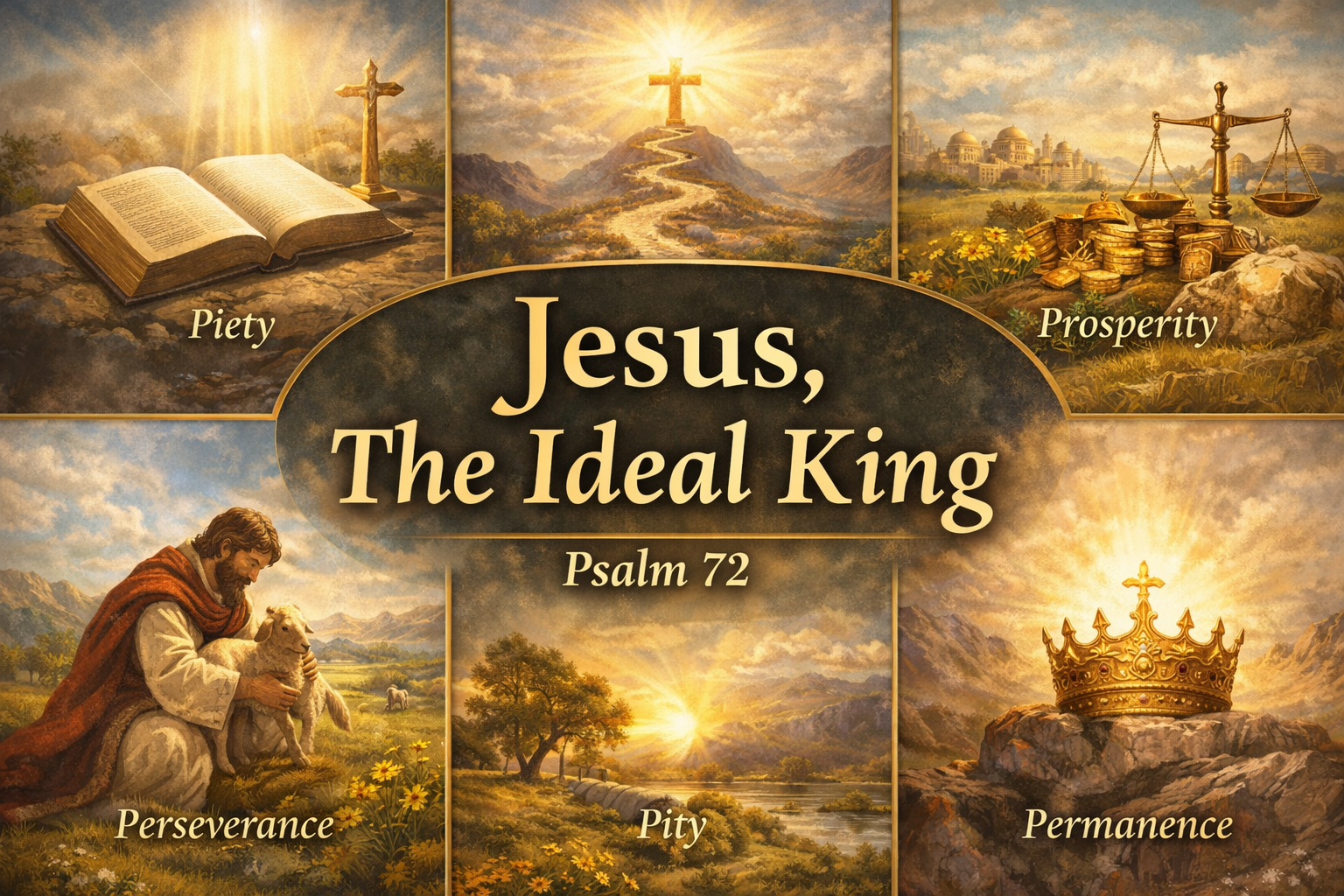
Jesus, The Ideal King 2-15-26 AM
I. His piety (Ps. 72:1-4).
a. David first prayed that his son would show a great spiritual devotion towards God.
b. Solomon needed to depend on the God for righteousness and justice.
i. We know Solomon did do this at the beginning of his reign.
ii. When told by God he could have anything, Solomon showed piety by asking for wisdom to lead (2 Chr. 1:7-10).
iii. He was just in his ruling, as when asked to judge between two mothers (1 Ki. 3:16-28 – notice verse 28).
c. Sadly, this piety did not extend through the entirety of his reign.
i. We know that Solomon gave in to the foreign wives he married.
ii. 1 Ki. 11:4.
d. Jesus, the Ideal King, remained dependent upon God for the entirety of His stay on earth.
i. John 8:29.
ii. Jesus was reliant upon God in prayer (Heb. 5:7-9).
iii. As we noticed last week, I come to do your will O God (Heb. 10:9).
e. There was not one instance where Jesus did His own will (John 6:38).
f. Most rulers we know of expect others to bow to them.
i. In the Old Testament, we read of kings holding out scepters and others bowing to them.
ii. We have heard of those who hold out a hand and the person coming to the ruler bows and kisses the ring.
g. Jesus, the Ideal King, is repeatedly found in prayer, bowing before the Father.
i. When big decisions were to be made, Jesus bowed in prayer.
ii. In Gethsemane, as soldiers were coming to take Him away, Jesus bowed in prayer.
h. Jesus was constantly and consistently dependent upon God, despite being God in the flesh.
i. If He was so dependent upon God, how much more should we?
II. His perseverance (Ps. 72:5-7).
a. David wanted Solomon to continue to be faithful to God all the days of his reign.
i. David understood the need for perseverance in faith.
ii. He had lived it out in his own reign.
b. If Solomon would do so, the people under his reign would be blessed and righteousness would flourish.
c. He would be a blessing to his people and they would be in peace.
d. Solomon, as we pointed out, did so for a time but then became unfaithful – he did not persevere in faithfulness.
e. Jesus, the Ideal King, persevered in faithfulness the entire time of His earthly stay.
i. He was faithful to God.
ii. He was also faithful to His followers.
f. Jesus never quit on God or on His people.
i. John 13:1.
ii. Heb. 13:8.
iii. 2 Tim. 2:13.
g. I’ve been to New Orleans twice.
i. If you’ve ever gone, you know that you go over Lake Pontchatrain.
ii. The bridge is the longest over water bridge in the world, spanning almost 24 miles.
iii. The first time I went over it, it was at night and it was very foggy.
iv. All I could think about was the my friend driving was going drive us over the side in the fog and we would end up with the alligators.
v. I was genuinely scared to even look out the window.
h. Imagine driving over that bridge and learning the engineer sometimes lost interest halfway through some of his projects.
i. Some he saw all the way through.
ii. Others, he simply left to the workers to finish with no oversight.
i. I wouldn’t go over it – I would just never have gone to New Orleans.
j. We wouldn’t trust that bridge.
k. Jesus never abandons what He begins (Php. 1:6).
l. Earthly kings and leaders change, but Jesus does not.
m. His faithfulness is not seasonal – it is eternal.
III. His prosperity (Ps. 72:8-11).
a. David wanted Solomon to be honored by others and to be prosperous.
b. This was definitely the case for Solomon.
i. God blessed him with more wealth than anyone in history.
ii. Leaders came from all over the known world to hear his wisdom and to learn from him.
c. But, when you read these words, it cannot be the case that this all fits Solomon.
i. Not all nations honored him.
ii. Not all kings bowed before him.
d. This has to point to the prosperity of one greater than Solomon.
e. Jesus was not prosperous in the sense of physical wealth.
i. He said He didn’t have anywhere to lay His head.
ii. We never read of a permanent residence for Jesus during His ministry.
iii. His own brothers did not believe in Him.
f. Jesus, the Ideal King, is prosperous in the sense of not losing any that God gives Him (John 6:39).
i. Jesus deals in souls.
ii. Nothing is more valuable than a human soul (Matt. 16:26).
g. Jesus is prosperous in mercy (Eph. 2:4).
h. Jesus rains that prosperity down on us (Rom. 10:12).
i. Notice how Micah describes God’s mercy (Mic. 7:18-19).
ii. Our Lord makes mercy available continuously (Heb. 4:16).
i. Jesus told a parable about a servant who was indebted to such a measure he would never be able to repay it.
i. The master forgave the debt completely.
ii. It was totally removed from existence.
iii. This is the mercy of Jesus – not merely reducing our debt, but completely removing it
j. This shows us the prosperity of Jesus, the Ideal King.
IV. His pity (Ps. 72:12-14).
a. David wanted for his son to be a king on whom the people could rely for pity and relief when in need.
b. Solomon showed that in his dealing with the two women we mentioned earlier.
c. We know this was fully fulfilled in Jesus, the Ideal King.
d. Jesus was not some social justice warrior.
i. But, He was extremely concerned about the poor and unfortunate.
ii. He was continuously gracious to them.
e. How many times do we read something like “He was moved with compassion”?
i. It was Jesus who touched the leper.
ii. It was Jesus who looked lovingly on a widow crying at the funeral procession of her son.
iii. It was Jesus who was moved to spare the life of a woman caught in sin.
f. Jesus was not detached from suffering – He was drawn to it.
i. He called for Blind Bartimaeus when others were telling the man to be quiet.
ii. He called for the children when others were telling them to go away.
g. Jesus touched the untouchable.
h. Jesus loves the unlovable (Rom. 5:8).
i. You and I are never invisible to the Ideal King.
V. His permanence (Ps. 72:12-17).
a. David wanted his son to rule over a kingdom that was vast and for his reign to go on for years.
i. The kingdom of Israel grew to its largest size under Solomon.
ii. He reigned for 40 years.
b. Sadly, because of Solomon turning from God, the kingdom failed to grow any larger and Solomon died before he had to.
i. God had promised Solomon a large kingdom since he asked for wisdom.
ii. God also told him he would have length of days as long as he remained faithful.
c. This section of the psalm is why the Jews consider this a Messianic Psalm.
d. This can only be said of God’s Anointed One and we know that to be Jesus, the Ideal King.
i. Luke 1:32-33.
ii. Heb. 1:8.
iii. Rev. 11:15.
e. Every earthly kingdom fades.
f. The kingdom of Christ never will.
g. One day I hope to visit Italy, Greece, maybe even Egypt.
i. I want to see the remnants of those great kingdoms.
ii. I want to see the Coliseum, Mars Hill, and the pyramids.
iii. Those are all ruins.
h. They were once unstoppable empires, but are now museums.
i. There will never be ruins of the kingdom of Christ.
i. His throne does not decay.
ii. His authority will never weaken.
iii. His reign will never end.
The Heavenly Tabernacle 2-8-26 PM
I. The Person offering the sacrifice (Hebrews 9:11).
a. The writer begins by pointing out the fact that Christ has come.
i. He did not use the name of Jesus, but His title.
ii. Jesus is the Christ, or the Messiah, and these people needed to be reminded that He was the One for whom they had been looking.
iii. This wasn’t some man, but the Anointed One.
iv. The phrase “being come” literally means “appearing as”.
b. When He came it was to be the High Priest, which our writer has already shown Jesus to be using Old Testament passages to prove it.
c. And He is the High Priest of good things to come.
i. The Greek language is a little ambiguous here.
ii. Some translations word it like the KJV and show the good things coming in the future tense.
iii. Others translate it in the past tense as the good things have already come (ESV - of the good things that have come).
iv. The language allows for either and both are true.
v. Jesus brought good things with Him and there are good things in store for us in the future.
vi. The good things to come do stand for the blessings we find in the New Covenant as will be pointed out later by our writer.
d. Those good things come to us from or through, which is the meaning of the word translated “by”, a greater and more perfect tabernacle.
i. This tabernacle, our writer tells us, is one that is not made with hands.
ii. It is not a physical tabernacle like that of the Old Covenant.
iii. It is one that is not of this creation, which is the meaning of the word “building”.
iv. Nothing like this creation is on earth, it is spiritual.
v. When Jesus ascended, He did so into heaven.
vi. This is where He is serving us as our High Priest and is giving us all those good things we have and that are to come.
e. Jesus, the Christ, is in this heavenly tabernacle, working for us.
i. We ought to take great comfort in this fact.
ii. He is in the presence of God, able to give us what we need when we come with our requests.
f. If Jesus were still on earth, He could not serve us in this way.
g. We needed Him to come, but we also needed Him to go back from where He came.
II. The preciousness of the sacrifice (Hebrews 9:12).
a. When the Aaron or one of his descendants went into the Most Holy Place on the Day of Atonement, he always went in with blood.
i. He entered with the blood of a bull for his sins and the sins of his family.
ii. He also had the blood of a goat, which was for the sins of the people.
iii. If he entered without these, he would have been put to death by God.
iv. These were needed to atone for the sins of everyone.
b. Jesus did not enter the spiritual Most Holy Place, which is heaven, with the blood of those animals.
c. Instead, Jesus was able to enter that spiritual tabernacle with His own precious blood.
i. Think of the price that was paid for the sins of the world.
ii. It came at tremendous cost.
d. The blood that was shed under the Old Law was to show people the price of sin.
e. There is no greater sacrifice that heaven could have made than to send God’s only begotten Son to pay the price for sin with His precious blood.
f. This ought to imprint on our minds the hatred for sin that God has.
i. It ought to convince us of the high cost of sin.
ii. It ought to convince us of the stand that God takes against sin.
iii. He will have no part of it or with those who live in it because He was willing to send His Son to pay for our sins and there is nothing left to take away our sin if we reject His Son.
g. This ought to also imprint on our minds the love that Jesus has for us.
i. The first verse tells us that the Christ came.
ii. This verse tells us why He came.
iii. He came to shed His blood for our sins.
h. What was given for us was not the blood of some animal, but the precious blood of Christ.
III. The permanence of the sacrifice (Hebrews 9:12).
a. One time a year the high priest would enter the Most Holy Place with the blood of bulls and goats.
i. This went from the time the Law was instituted until temple was destroyed in AD 70.
ii. The sacrifice was only effective until the death of Christ and His resurrection and ascension, but they continued with the sacrifices because of their rejection of the Lord.
iii. About 1,500 years passed between the giving of the Law and AD 70.
iv. So there were about 1,500 Days of Atonement.
v. Every year the people were reminded of their sin.
b. Jesus, the Great High Priest, offered His precious blood one time for all time.
i. The word “once” literally means upon one occasion only, at once for all.
ii. The blood of Christ is so powerful it only had to be offered once.
iii. The reason for this is that it totally washes away the sins of man.
iv. Animal blood only pushed them forward.
c. Why would these people want to go back to something that only reminded them of their sin and had to be offered every year, along with any other sacrifices that they needed to make throughout the year?
d. Leaving Jesus leaves the only blood that can take away sin.
e. Why would anyone want to leave this precious blood today that removes our sin?
IV. The power of the sacrifice (Hebrews 9:12-14).
a. The power of the sacrifice under the Mosaic Law was very limited.
i. It did not last long.
ii. It had to be offered once a year.
iii. It simply reminded the people of their sins.
b. The sacrifice of Jesus is far more powerful than all of the sacrifices of the Mosaic Law combined.
c. His blood is so powerful it obtained eternal redemption for us.
i. The word obtained is translated “secured” in other translations.
ii. His blood was able to remove our sins eternally.
iii. It is powerful enough to wash all the sins of God’s people who lived under the Mosaic Law.
iv. It is powerful enough to wash all our sins away as well.
v. It is secured forever.
vi. There is never going to be another sacrifice needed.
d. The writer pointed out that the blood and the sprinkling of water under the Old Law purified the flesh.
i. Blood had to be shed for sin and for rituals that involved those that had become impure.
ii. Also, when one had become unclean for some reason, he had to be sprinkled with water that had mixed in it, the ashes of a red heifer that had been sacrificed.
iii. You can read about this in Numbers 19.
iv. These were done to purify the flesh.
e. If that could purify the flesh, our writer says, think how much more the blood of Christ can purify your conscience!
f. We’ve often said in this study that the Old Law appealed to the outward man, the flesh, while the New Law appeals to the inward man, the spiritual.
g. If blood and water can purify the flesh, the blood of Christ is more powerful because it purifies the conscience.
h. It can because the blood of Christ is without spot, there is no impurity from sin or some other uncleanness in it.
i. The eternal Spirit through which He offered Himself to God has one of two meanings:
i. It may mean the Holy Spirit, in that Jesus offered Himself up for man to God with help of the Holy Spirit.
1. This would have all three members of the Godhead working together in the sacrifice of Christ.
2. It may be this.
ii. Or, it may mean the divine aspect of Christ, that which made Him deity.
iii. Either of these two beliefs is in line with what the New Testament teaches about the sacrifice of Jesus.
j. The word translated purge is the word from which we get the English word “catharsis”.
i. It means to purify from the pollution of sin.
ii. It is a complete removal of that pollution by the blood of Christ.
k. That which is purged is our conscience.
i. The conscience is that part of our makeup that gives us pain when we do what we consider to be wrong, and commends us when we do what we consider to be good.
ii. Only the blood of Christ can purify, or purge out all the sins that have affected our conscience.
iii. We bear the weight of our sin in our conscience.
iv. The blood of Christ removes that weight and it is only the blood of Christ that can do this.
l. Coming into contact with the blood of Christ will purge one from a desire to do those things that kill us, sinful things.
m. What it causes us to do is have a desire to serve God!
i. Think how powerful that is: having the ability to turn us to God, away from the world and all of its sin.
ii. It turns us into servants of God.
n. How could it not?
i. It was the Son of God acting on our behalf.
ii. He did something for us that nothing or no one else could do: obtain eternal redemption for us.
iii. How could we not want to serve the God who put this plan into motion to save us from our sins?
Jesus, The Obedient Son 2-8-26 AM
I. Spoken obedience (Ps. 40:6-9).
a. Notice these phrases in the text.
i. My ears you have opened (vs. 6).
ii. I have preached righteousness (vs. 9).
iii. I have not refrained (or restrained) my lips (vs. 9).
b. The obedience of Jesus begins with listening attentively.
i. The Lord heard the words of the Father and took them in.
ii. He listened to all of them, not just some of them.
iii. There is no way Jesus could have been fully obedient if He did not know all the will of the Father.
c. Because Jesus listened so attentively, He was able to teach perfectly the will of the Father to those that would listen to Him.
d. Jesus did not speak what He came up with on His own.
i. John 7:16.
ii. John 12:49.
e. The Hebrews writer applies this directly to Jesus – I have come to do your will, O God.
f. Think about that:
i. Every sermon, parable, or declaration of truth that Jesus spoke was from God.
ii. The came from a heart fully aligned with the Father.
g. Obedience is the doing the will of the Father and not our own.
h. It begins with hearing the voice of God in the gospel (Rom. 10:17).
i. We have to listen to God’s word in order for faith to form.
ii. Faith in God’s word moves us to be obedient (Matt. 7:24).
iii. It is hearing first, then doing.
i. Just like Jesus, when we hear we will tell.
i. We won’t be able to help it.
ii. It will come from a grateful heart, knowing what has been done for us can be done for the person we are telling.
iii. Think about how we act when something good has been done for us at a store or a restaurant – we tell everyone.
iv. It should work this way with the gospel.
j. Jesus exemplifies spoken obedience in that His words were the words of the Father.
k. We need to make sure our words line up with God’s word and follow the example of Jesus telling the things of God that we have heard.
II. Shown obedience (Ps. 40:8).
a. The Psalmist said, “I delight to do your will…”
i. Twice in the 119th Psalm David said something similar.
ii. Ps. 119:16, 47.
b. It was a pleasure for David to do the will of God.
i. For David, it was not just words.
ii. It was a doing of the will of God.
c. Notice why this was the case: “Yea, your law is within my heart.”
i. Also in Psalm 119, David said “Your word have I hid in my heart that I might not sin against you” (vs. 11).
ii. David kept God’s word stored in his heart and it helped him do the will of God.
d. Jesus perfectly embodied this while on earth.
e. The obedience of Jesus was visible to all by the way that He lived.
i. He was not bragging when He said I do always those things that please Him.
ii. He was telling the truth.
iii. Everything that Jesus did was what God wanted Him to do.
f. The Hebrews writer compares the life of Jesus with the empty sacrifices of the Old Testament.
i. There were those who went and offered the right sacrifices but weren’t right with God.
ii. Jesus did the will of the Father and that is what pleases the Father.
g. Jesus didn’t just say the right things.
h. Jesus lived out the right things in every action of His life.
i. His obedience was not out of duty or because He was forced.
j. It was His delight to do the will of the Father.
k. We have to get to the point where it is a joy for us to serve God and not a burden.
i. We might say “Why do I have to do this or that” when it comes to living for God.
ii. We should be growing to the point where we do the right thing because we love God and it brings us joy to serve Him.
l. True obedience is not a reluctant compliance with the will of God, but willing submission that shows up in how we live.
m. People can tell when actions are forced or fake.
n. Our lives should so to the world a delight in doing God’s will.
III. Sacrificial obedience (Ps. 40:6-7).
a. God did want sacrifices to be made under the Old Testament law.
i. We read of Him commanding that they do be made.
ii. This is not what the Psalmist is saying.
b. God wanted those sacrifices to be made, not of ritualism or compulsion, but out of love for Him and a desire to please Him.
c. Ultimately, all the sacrifices made in the Old Testament were to show that they were not enough.
d. What Psalm 40 looks to, or anticipates, is a time when obedience would replace ritual.
e. Hebrews 10:10 makes it unmistakable – Jesus is the One who came to offer Himself, not animals.
f. The obedience of Jesus reached its fullness, or its climax, in death.
i. He submitted His body to the cross, completely fulfilling the will of God completely and finally.
ii. What Old Testament sacrifices could never accomplish, His obedient death achieved forever.
g. You and I must have a sacrificial obedience as well (Rom. 12:1).
i. We make the sacrifice of self.
ii. We give ourselves, our power, our strength, to God.
iii. It may cost our physical lives, but every day, we give ourselves to God and show Him that we are obedient to His will.
h. We sacrifice what we want for the will of God.
i. We do this because of the sacrifice of Jesus for us.
Jesus, The Good Shepherd 2-1-26 AM
With Jesus as our Good Shepherd, we do not want for:
I. Provision (Ps. 23:1-2).
a. David writes that God provides him with food and water.
b. The role of a shepherd was the role of complete provider.
i. He was to take the flock to the right fields.
ii. He was to take the flock to still waters, because moving water is frightening to sheep.
c. To properly do this, the shepherd has to know the type of grass, because some types are harmful to sheep.
d. To properly do this, the shepherd has to know where the good watering places are.
e. Jesus makes sure you and I provided for with the very best spiritual food.
i. He provides Himself (John 6:53-54).
ii. There is no higher source of spiritual provision that Jesus Himself.
f. Jesus provides us His word (1 Pe. 2:2) to make sure we are sustained and able to grow.
g. At the beginning of John 6, we read of Jesus feeding the 5,000.
i. He had a hungry crowd but did not send them away.
ii. Instead, Jesus fed them and did so abundantly.
iii. We also read that He wanted to provide much more for them but they would not allow Him to because they rejected Him as Savior.
h. Sheep don’t provide for themselves – the shepherd brings them to the right field and the right watering hole.
i. Jesus, the Good Shepherd, provides for us all that we need spiritually and does so abundantly.
II. Path (Ps. 23:3).
a. David writes that God leads him on the path of righteousness.
b. It is interesting that the words translated “leads” or “leadeth” in verse 2 and 3 are different Hebrew words.
i. The word in 2 means to lead gently and peacefully.
ii. The word in 3 means “lead carefully toward a definite goal according to a definite plan.”
c. There is a pathway laid out for God’s people by the Good Shepherd (John 14:6).
i. Jesus is the way.
ii. His way is a way of righteousness.
d. Righteousness is right living according to God’s standard and Jesus provides the map for this type of life.
i. Some fail to follow this path.
ii. 2 Pe. 2:21.
e. Jesus reveals the way of righteousness for us (Matt. 7:13-14).
f. Jesus modeled the way of righteousness for us as well (John 8:29).
g. God has always been a God who leads in the right way.
i. Ex. 13:21-22.
ii. God was leading Israel with a cloud or fire, depending on the time of day.
iii. The Israelites didn’t know the route, but they knew the Guide.
iv. They didn’t have to know the way, they just had to follow.
h. Sheep are well-known for getting lost.
i. The shepherd’s job is to lead the sheep on safe paths.
ii. Sometimes the path would be unfamiliar to the sheep.
iii. The shepherd still has to patiently guide.
i. Jesus patiently guides us on the way of righteousness.
i. He corrects our paths if we allow Him.
ii. He does this through various means but we have to pay attention so we stay on the right path.
III. Presence (Ps. 23:4).
a. David wrote that God was with him through every difficult part of his life.
b. When you look back on the life of David, you realize quickly that there were some very difficult parts of it.
i. His being chased by Saul, wanting to kill him.
ii. His being pursued by the Philistines at the beginning of his reign.
iii. His being pursued by his son Absalom, even though David had caused the problem.
c. David knew that in each of those situations, and in ones we probably don’t know about, God was right there with him.
d. Jesus has promised that He will be with us until the end (Matt. 28:20).
i. Until death, Jesus is right there with us.
ii. In every dark, lonely situation in which we may find ourselves, Jesus is right there with us.
e. He is the God of all comfort (2 Cor. 1:3-4).
i. Notice that it says in “all our tribulation.”
ii. Not some of, or, in parts of, but in all our difficulties, comfort is provided.
f. Think of what Jesus is doing for us:
i. Jesus intercedes for us (Rom. 8:34).
ii. Jesus advocates for us (1 Jn. 2:1).
iii. Jesus is in the midst of His church (Re. 1:13, 20).
g. For Jesus to be able to properly do these things, He has to be present in our lives at all times.
h. In Mark 4:35-41, we read of Jesus saving His disciples from the stormy sea.
i. Jesus was with them, but this didn’t stop the storm from coming.
ii. But, because Jesus was with them, it made deliverance from the storm a certainty.
i. David didn’t say “I will fear no evil because I am strong.”
j. David said he would fear no evil “because you are with me.”
IV. Protection (Ps. 23:5a).
a. David wrote that a table had been prepared by God for him in the very presence of his enemies.
b. When a shepherd took his flock anywhere, he remained vigilant for predators.
i. While taking them to the green pastures, he was watching for wolves, bears, or lions.
ii. While placing them at the still waters, his eyes were open and watching for anything harmful.
c. David knew this well (1 Sam. 17:34-36).
d. David tells God that he knew he could rest and cared for even though his enemies were near.
e. He had faith in the protection of God.
f. Jesus provides protection from Satan.
i. He reveals to us how to defeat temptation (Matt. 4:1-11 – “it is written”).
ii. He provides the knowledge of how to resist Satan so he will flee from us (Jam. 4:7).
g. Remember the words of John 10:11.
h. At the cross, Jesus didn’t just scare off Satan, He defeated him, allowing us to be protected from Satan if we will stay with Jesus.
V. Prosperity (Ps. 23:5b-6).
a. David felt his cup was running over and he had all that he needed.
b. David realized what he needed was God’s goodness and mercy all his days and he would be prosperous.
c. Jesus provides us with this prosperity.
i. All the grace we need is found in Jesus (Tit. 2:11).
ii. All the goodness of God we need is found in Jesus.
iii. All the mercy we need is found in Jesus (Jude 1:21).
d. These are the things that cause us to be truly prosperous, not anything financial or physical.
e. We are rich in these things when Jesus is with us.
f. When you look at the life of Joseph, you see a picture of Psalm 23.
i. Joseph was betrayed by his brothers, sold into slavery, falsely accused, imprisoned, and forgotten.
ii. However, at each of those stages we read, “The Lord was with Joseph.”
iii. Eventually, Joseph would say… (Gen. 50:20).
iv. Joseph’s prosperity was not constant comfort, but the constant goodness and mercy of God.
g. Paul echoes Psalm 23 to the Philippians (Php. 4:19).
h. Also, to the Romans (Rom. 8:32).
i. Biblical prosperity is not getting everything we want – it is never lacking the goodness and mercy of God, no matter where His path leads us.
j. When Jesus is our Good Shepherd, our cup does not merely get by, it overflows with grace and mercy.
Jesus, The Crucified One 1-25-26 AM
I. The separation of Jesus.
a. The famous phrase, My God, My God, why have You forsaken Me, is one that stays with us.
i. There are seven sayings of Jesus that are on record in scripture.
ii. We might not remember each of them, but we remember this one.
b. There is debate about the meaning of this saying when Jesus says it.
i. On one side of the debate are those who say that Jesus quoted from Psalm 22 to teach those at the cross that He was the fulfillment of that Psalm, the Messiah.
ii. On the other side of the debate are those who believe Jesus, though quoting the psalm, was crying out in desperation because of His being separate from the Father for the first time.
c. Good brethren are on both sides of this issue.
d. My stance on it is, and this could change, is that the human side of Jesus longed for the presence of God but knew God could do nothing for Him if mankind was to be saved, but the divine side was still teaching – really a mix of both views.
i. If God did send Him relief or save Him from the cross, you and I have no hope for salvation.
ii. This is the reason Jesus came into the world and He was well aware of it.
e. Jesus was experiencing a separation from God the Father that had never occurred, nor would ever occur again.
i. Jesus and God were one (Jn. 10:30).
ii. They were constant companions during the earthly life of Jesus.
f. In this moment, Jesus felt abandonment because God could not do anything for Him.
i. The psalmist said he felt like a worm and a reproach (Ps. 22:6).
ii. No doubt Jesus felt this way on the cross.
g. The very next verses in Psalm 22 says…(Ps. 22:7-8).
i. This is exactly what happened at the cross.
ii. Matt. 27:39-43.
h. Can you imagine being so close with someone and that person be unwilling to help you in your moment of greatest need?
i. Imagine this from the Father’s point of view though.
i. There He is, looking down at His only begotten Son.
ii. He sees each slap, lash of the whip, each blow on a nail with the hammer.
iii. He sees the thorns pressed down on His brow and into His head.
iv. He could have stopped it but it would ruin the plan He had created before the world began to provide salvation for His special creation.
v. It is no wonder that God caused the sun to be dark for three hours in the morning of that fateful day.
j. I cannot fully comprehend what the Father and Son were both feeling that day.
k. I have never endured what Jesus was enduring and I have never been in a situation where I could help one of my children but it would make life worse for all others.
l. Jesus also wanted to save people.
i. They needed to understand who He was.
ii. He was the Messiah for whom they were looking and this death should have let them know.
iii. The Jews all believed that this psalm was Messianic in nature.
iv. They knew that David had never experienced the piercing of his hands and his feet.
v. They knew that David never had his garments distributed to others and gambled for by those around him.
vi. Those people at the cross needed to understand who Jesus was.
m. The human side of Jesus cried out because of the separation from God He felt, while the divine side of Jesus cried out for the salvation of those at the cross.
II. The suffering of Jesus.
a. In Psalm 22, the psalmist describes how his enemies felt to him (Ps. 22:12-13, 16, 21).
i. They felt like bulls of Bashan – Bashan was known for its lush pastures, which allowed for the bulls of that area to grow strong.
ii. It seemed to David as if his enemies had the power of lions.
iii. The biting of dogs was in the mind of David at this time.
iv. It seemed to David as if his enemies were about to gore him like an ox would gore someone, which is the meaning of the KJV unicorn.
b. Listen to how David felt in the moment (Ps. 22:14-17).
i. He is empty, poured out like water.
ii. He aches in pain.
iii. His heart is melted.
iv. His strength is gone like broken pottery.
v. His mouth is so dry that his tongue is sticking to the roof of his mouth.
vi. He feels he is about to die.
c. All of this vividly describes what Jesus suffered while on the cross.
d. All of us have known physical pain to varying degrees.
i. We may have broken bones.
ii. We may have been pierced by a knife or some sharp instrument.
iii. We may have experienced a lack of water for some time.
e. We can empathize with the Savior in that regard.
f. However, none of us have ever experienced the weight of all the sins of mankind, never having committed a sin ourselves.
i. We all know the weight of our own sins and the pain they bring.
ii. Jesus was the sinless, perfect Son of God.
iii. He bore the weight of all of our sins while on the cross.
iv. 2 Co. 5:21.
g. Think of what Jesus endured when you read those verses in Psalm 22.
i. Those nails were pushed through His skin and pierced through nerves, so we can understand His aches and His strength being gone.
ii. He experienced a great amount of blood loss, so we can understand He feels like He has been poured out like water.
iii. He cried out that He was thirsty, so we can understand His tongue clinging to the roof of His mouth.
iv. We read that when the soldier pierced His side that forthwith came out blood and water – Jesus died of a broken heart, so we can understand why the Psalmist would say His heart was melted.
h. Both the human and divine side of Jesus suffered greatly while on that cross.
III. The sureness of Jesus.
a. David, in Psalm 22, closes his writing by praising God as if God had taken him out of the terrible situation.
i. He was absolutely sure that God would save him.
ii. This is the great faith that David had in God.
iii. God had been there for him in the past, and even though He was not answering David right away, God would be there for him now.
b. Despite the fact that Jesus felt separation from God in that dark time, He knew that God would not leave Him completely.
c. I find the wording of Mark 15:33-34 very interesting.
i. Mark tells us that there was darkness over all the land at nine in the morning.
ii. We mentioned the darkness earlier and why we could understand God doing this.
d. But, did you notice the timing in these two verses?
i. There was darkness from the 6th to the 9th hour.
ii. It was at the 9th hour that Jesus cried out, My God, My God, why have You forsaken Me.
iii. This reads, at least to me, that when our Lord cried out, God restored light, as if to say to Him, I’m still here.
e. Jesus, though feeling separate from God, is reminded that the Father was present and it gave Him a sense of sureness in the fact that God would take care of Him.
i. Despite all that had gone on, the Father was there.
ii. The Father had promised to resurrect Him and Jesus was sure that He would keep His word.
f. It was after this that Jesus said, “Father, into your hands I commend My spirit” (Lu. 23:46).
g. Every time that Jesus told His disciples He had to die, He also would say that He would be resurrected.
i. Jesus was sure of this.
ii. Even in the moment of His last breath He was sure that the Father would take care of Him and bring Him back to life.
Jesus, The Resurrected One 1-18-26 AM
I. The proof of the empty tomb.
a. As we think about the resurrection, there needs to be an understanding of its proof.
b. The resurrection is a real historical event.
c. The first proof of the resurrection is that it was prophesied:
i. This psalm, 16, is a prophecy of it.
ii. Isa. 53:8-10 is a prophecy of it.
iii. Jesus prophesied that He would be raised from the dead (Mt. 16:21; 17:22-23; Jn. 2:19; 10:17-18).
d. Another proof of the resurrection is the empty tomb itself.
i. Peter pointed the people at Pentecost to David’s tomb (Ac. 2:29) and then used David’s words to point to the resurrection of the Messiah.
ii. Remember what the Jewish leaders told the guards who were at the tomb of Jesus (Mt. 28:13).
iii. Now notice verse 15.
e. Another proof of the resurrection is the number of witnesses to the resurrected Savior.
i. 1 Cor. 15:5-8.
ii. Peter and John also claimed to be eyewitnesses of the resurrected Christ (Acts 3:15; 1 Jn. 1:1-3).
f. Another proof of the resurrection is the change in Saul of Tarsus.
i. Think of how his life changed after meeting and seeing Jesus on the road to Damascus.
ii. He had terrorized the church so much that he would later call himself chief of sinners.
iii. He then began to preach the truth of the Savior, to the point that he would be persecuted in terrible ways, eventually dying for Jesus (2 Cor. 11:24-28).
iv. No one drastically changes their life like this for a lie.
g. Another proof of the resurrection is the change in the lives of the brothers of Jesus.
i. These men did not believe Jesus was divine at first (John 7:3-5).
ii. After the resurrection, we see them with the apostles (Acts 1:13-14).
iii. One of them was inspired to write a letter found in the New Testament (Jude) and another was described as a pillar of the church in Jerusalem and also inspired to write a letter found in the New Testament (James – Gal. 2:9).
h. In a day of skepticism and doubt, there is more than enough proof of the resurrection to remove both in our minds.
II. The place of the empty tomb.
a. When I use these words together, you may think I’m talking about the physical location of the empty tomb.
b. There are tombs in the area of Jerusalem that are said to be the empty tomb.
c. I have no idea which, or if any, of those tombs held the body of our Lord.
d. What I mean with this sentence is the place of the empty tomb in the gospel of our Lord.
e. I believe, without any hesitancy, is that the resurrection is the most important event and doctrine of the whole gospel.
i. One writer stated, “There would be no gospel, not one account, no epistle in the New Testament, not faith, no church, no worship, no prayer in Christendom to this day without the message of the resurrection of Christ.”
ii. Another writer calls the resurrection “the watershed of New Testament history and the central point of its faith.”
f. We could go on with quotes about it, but notice what the New Testament shows us about the centrality of the resurrection to its teaching.
g. Look at the sermons and teaching in the book of Acts that have the resurrection as their center point (Acts 2:24, 31-32; 3:15, 26; 4:2, 10; 5:30; 10:40; 13:30-37; 17:31; 25:19; 26:22-23).
h. Paul stated it was one of three core tenets of the gospel that he preached to the Corinthians (1 Cor. 15:1-4).
i. It is central to the doctrine of Christ Himself (Rom. 1:4; Acts 2:36).
j. It is central to the work of Jesus as our Redeemer (after the resurrection Jesus was exalted (Acts 5:30-31; Rom. 4:25).
k. The doctrine of the church is dependent on the resurrection:
i. Jesus was made the Head of the church because of it (Eph. 1:20-23).
ii. The mission of the church is tied to the resurrection (Jesus gave the Great Commission after His resurrection and we are to tell others about it).
l. The worship of the church has the resurrection as a central theme.
i. The day on which we worship is the first day of the week, corresponding to which day of the week the resurrection took place.
ii. The Lord’s Supper looks to the death of but also the resurrection of Jesus (1 Cor. 11:26 – it is to be done until He comes).
m. The effectiveness of baptism depends on the resurrection (Rom. 6:3-5).
n. Our hope is based on the resurrection (Re. 1:5, 18).
o. The place of the empty tomb in the life of a Christian, Christianity itself, is at the very center of all things.
III. The proper posture towards the empty tomb.
a. When we, in our minds, stand before that empty tomb, what should be our response?
b. The first response should be faith (Rom. 10:9-10).
c. The second response should be worship (Mt. 28:8-9, 17; John 20:28).
d. The third response should be joy (Mt. 28:8; John 20:20).
e. The fourth response should be hope (Acts 24:14-15; 1 Cor. 15:19).
f. The fifth response should be to tell others (Matt. 28:7, 10, 19; Acts 4:20).
Some material for this sermon came from articles by Dr. Stephen Williams, one of my professors at Amridge Univ.
The Physical Tabernacle 1-11-26 PM
I. The description of the physical tabernacle (Hebrews 9:1-5).
a. Verse 1 lets us know that the writer is speaking about things under the first covenant.
i. The word “ordinances” means legal rights.
ii. There were things that had to be done before God, which would include the sacrifices, thank offerings and things like that.
iii. It also had a sanctuary, or tabernacle on earth, which is the meaning of worldly.
b. The tabernacle that was made is described in Exodus 26.
i. In that chapter we read of the covering for the tabernacle, as well as the fact that there were two areas, the holy place and the most holy place.
ii. Verse 2 contains what was in the holy place.
c. In the holy place, all the priests could enter and do the work that was required there.
d. The lampstand was there.
i. This is spoken of in Exodus 25:31-40 and Exodus 26:35.
ii. It was placed on the south wall of the tabernacle.
iii. It was made of gold and had seven lamps for burning the olive oil.
iv. This lampstand was never allowed to go out.
e. The next piece mentioned is the table.
i. This is spoken of in Exodus 25:23-30, Exodus 26:35.
ii. This table was overlaid with pure gold and it was set against the north wall of the tabernacle.
f. On it sat the next item mentioned, which is the shewbread.
i. This bread is described for us in Leviticus 24:5-9.
ii. There were 12 loaves kept on the table, being set up in 2 rows of 6.
iii. Every sabbath day, fresh loaves were brought in and the old ones were eaten by the priests.
g. There was then a veil that was set up between the holy and most holy places.
i. In this area, only the high priest could come once a year.
ii. The veil is described in Exodus 26:31-33.
h. The first item mentioned is the censer.
i. It is interesting that there is disagreement over what this is.
ii. Some believe it to be the golden altar of incense that was placed right next to the veil in the holy place.
1. It is described in Exodus 30:1-10.
2. Some believe the writer is describing this and that it is said to be in the most holy place because the incense, which represent prayers, was always before the presence of God.
iii. Others believe it to be the censer that was used every year by the high priest to bring in the incense before the mercy seat.
i. He then mentions the ark of the covenant.
i. This was a chest made of a certain type wood that was four feet long and two and half feet wide (Exodus 25:10-16).
ii. It was covered with gold and it was the most sacred item in the tabernacle.
iii. In it was contained:
1. The golden pot of manna (Exodus 16:32-34).
2. Aaron’s rod that budded (Numbers 17:1-11).
3. The tablets containing the 10 commandments (Deuteronomy 10:1-5).
j. Over the ark was the mercy seat.
i. This is described in Exodus 25:17-22.
ii. The Lord would appear in a cloud above the mercy seat (Leviticus 16:2; 2 Kings 19:15).
k. The writer tells us that he does not have time to talk about these things any more.
i. There is a great deal that could be said about them.
ii. Each item were shadows of things to come in the New Testament.
iii. However, that was not his purpose, and it isn’t ours either.
II. The ritual of the physical tabernacle (Hebrews 9:6-7).
a. The writer briefly describes the work done in the first part of the tabernacle, the holy place.
b. There was work to be done every day in the temple.
i. They would trim the lamps on the lampstand (Exodus 27:20-21).
ii. They would offer incense on the altar of incense (Exodus 30:7-8).
iii. On the sabbath day, they would change out the shewbread (Leviticus 24:5-9).
c. In the most holy place, only the high priest could enter and then, only once per year.
i. Leviticus 16:2 tells us the high priest would die if he came in any other time.
ii. He would enter in on the Day of Atonement, which was the 10th day of the 7th month (Leviticus 16:29).
d. When he went in, he would do three things:
i. He would offer the incense to cloud the mercy seat (Leviticus 16:12-13).
ii. He would sprinkle the seat with the blood of a bull, as a sin offering for himself and his family (Leviticus 16:11, 14).
iii. He would sprinkle the seat with the blood of a goat, as a sin offering for the people (Leviticus 16:15).
e. This is then a summary of what went into the tabernacle and the work done in it.
III. The limitations of the physical tabernacle (Hebrews 9:8-10).
a. There were some things that were symbolic about the physical tabernacle.
i. The writer already told us that it was an example and shadow of heavenly things (Hebrews 8:4-5).
ii. Hebrews 10:1 and Colossians 2:16-17 tells us that the law served as a shadow of that which was to come.
iii. It served as symbol for what would come in Christ.
iv. It symbolized what the Lord would do for us in reality when He entered heaven.
v. The writer will discuss this in the rest of chapter 9.
b. This was inspirations way of showing that the way into heaven was not yet opened for man.
i. As long as the first tabernacle was in use, which would also include the temple, the way to heaven was shut.
ii. It would take Jesus to open it, which will be discussed later as we just mentioned.
c. The limitations mentioned here are that they sacrifices and gifts offered by those that came to the tabernacle didn’t make the offerer perfect concerning his conscience.
d. The ceremonies involved carnal or physical ordinances that were to be observed until worship was to change.
i. Just as the tabernacle was earthly or physical, so were the ordinances of worship.
ii. We know that in heaven, it is spiritual.
iii. The things done under the Old Law were done to satisfy the physical senses of man.
iv. These were all designed to be temporary.
v. In the times of reformation, now, God demands that which is spiritual.
vi. This worship focuses on the inner man.
1. Singing from the heart.
2. Using our minds to remember Jesus during the Lord’s Supper.
Jesus, Son Of Man 1-11-26 AM
I. The reality of the incarnation.
a. The New Testament clearly teaches that God came to earth in the form of a human.
b. Coming to earth in the form of a human, He was both human and deity.
c. John makes this very plain.
i. John 1:1-3, 14.
ii. 1 John 1:1-3.
iii. 2 John 1:7.
d. Paul attested to it.
i. Gal. 4:4.
ii. Php. 2:5-8.
iii. Col. 1:15-17.
iv. Col. 2:9.
e. Notice what the Hebrews writer stated (Heb. 1:1-3 – the express image of His person).
f. Jesus stated the fact of His incarnation:
i. John 6:38.
ii. John 8:58.
iii. John 17:5.
g. When you look at the life of Jesus, it shows that He was both human and divine.
h. Jesus had human emotions and needs.
i. Jesus was hungry after fasting for 40 days.
ii. Jesus was tired and slept, evidenced by sleeping in the boat during a storm.
iii. Jesus wept because of His love for Lazarus.
iv. Jesus loved His mother enough to look out for her while on the cross.
i. Jesus performed miracles that showed His deity.
i. He had power over sickness and disease.
ii. He had power over nature.
iii. He had power over spiritual beings in the form of demons.
iv. He had power over death.
v. He appealed to people to believe in Him as the Messiah because of the miracles He performed (John 10:37-38; 14:11).
j. All of these point to the incarnation as biblical truth.
II. The refutation of false ideas.
a. As has been mentioned, this doctrine has long caused problems for many.
b. Numerous false doctrines have arisen trying to deal with this issue.
c. Some of them still exist today.
d. The first false idea is known as Docetism.
i. This is the idea that all flesh is evil so there is no way that deity took on flesh, He just appeared to be human.
ii. If Jesus was not fully human, He could not suffer as a man or die as a man.
iii. Someone has said about this that if there is no real humanity, there is no real atonement.
iv. John 1:14, Luke 24:39, and 1 John 4:2-3, and other passages, all refute this.
e. Another false idea is known as Adoptionism.
i. This teaches that Jesus was just a man who was later adopted by or given power by God.
ii. This denies His eternal existence and makes Jesus just a really good man.
iii. If Jesus is not truly deity, then He cannot be a sufficient Savior.
iv. John 1:1, Php. 2:6-7, and other verses, refute this idea.
f. Another false idea that is still in existence today is Arianism.
i. This false idea teaches that Jesus was the first and greatest created being.
ii. It is still seen in Jehovah’s Witness teaching.
iii. If Jesus is not God, why are we told to worship Him, which would be idolatry, which is condemned in scripture?
iv. John 1:3 says all things were created by Him and we know Jesus could not have created Himself.
v. Hebrews 1:8 shows that the Father calls the Son God.
g. Another false idea is Monophysitism.
i. This teaches that Jesus has only one nature, which is a mixture of divine and human.
ii. This idea destroys the teaching of Jesus being both fully divine and fully human.
iii. If Jesus is not fully both, He cannot represent man to God or God to man.
iv. Heb. 4:15 shows Jesus to be fully human in that He was tempted just like you and me.
v. Col. 2:9 shows Jesus to be fully divine in that all the fullness of Godhead dwelt in Him bodily.
h. A newer false idea about the incarnation can be called a functional denial.
i. This teaches that Jesus may be divine in influence or symbolism, but was not literally incarnate.
ii. To those that believe this, the incarnation is just a metaphor.
iii. Metaphors don’t cry, hunger, or bleed and symbols don’t rise from the dead.
iv. 1 Tim. 3:16 tells us that God was manifested in the flesh.
v. 1 John 1:1 says that the Word was seen, heard, and touched.
i. The 2nd Person of the Godhead came to this earth, took on flesh, and lived, died, and was resurrected among us.
III. The reasons for the incarnation.
a. A good question to ask is “Why was there a need for God to come to earth?, or, “Why was there a need for the incarnation?”
b. One reason is that it fulfills prophecy.
i. Isa. 7:14; 9:6-7.
ii. Mic. 5:2.
iii. Gen. 3:15 is the first one that indicated the incarnation.
c. Another reason is that the incarnation reveals God to us.
i. John 1:14.
ii. John 14:8-9.
iii. John 10:30.
iv. Heb. 1:3.
d. Another reason is man’s redemption depends on it.
i. Jesus came to offer Himself as the perfect sacrifice for our sins.
ii. Matt. 20:28.
iii. Heb. 2:9.
e. Another reason is to defeat sin and death.
i. Heb. 2:14-15.
ii. Jesus coming to earth in bodily form allowed for Him to experience death and then be resurrected, which 1 Cor. 15 shows to be the destroyer of death for us.
f. Another reason is the establishment of the kingdom, or church.
i. Jesus prophesied He would build a church (Matt. 16:18).
ii. It took His blood to purchase it (Acts 20:28).
g. Another reason is to model perfect humanity.
i. Jesus, by taking on flesh, models perfectly for us how we should be living.
ii. Php. 2:5-8.
h. Another reason is to sympathize with us.
i. Heb. 2:17-18; 4:15.
ii. He knows what we are going through and is able to appeal to God on our behalf because of that.
IV. The results of the incarnation.
a. When you take all this into consideration, there should be two results that come from the incarnation of Jesus.
b. The first is that we should obey Jesus in everything.
i. When we think about what Jesus gave up to come here, we should be awed.
ii. When we think about what Jesus suffered, we should be crying.
iii. When we think about what is ours because of this, we should be obedient.
c. The second takes us back to the start and finish of Psalm 8.
i. Ps. 8:1, 9.
ii. We should worship God.
d. He is the One who provided the Savior for us and we should worship Him with all that we are.
Christ Is King 1-4-26 AM
I. The rejection by the nations (Ps. 2:1-3).
a. This first stanza is seen from the viewpoint of nations that reject God.
b. We see they are raging against God and His anointed.
i. This is important to our understanding of this text being about Jesus.
ii. The word for “anointed” is the Hebrew word for Messiah.
iii. Many newer translations have this word capitalized as they understand it is a reference to Jesus and the divine.
c. The word translated raging means to assemble tumultuously.
d. The word for imagine carries the idea of conspire.
e. The gentile nations are pictured as coming together to conspire against God in a violent way.
i. They are setting themselves against God.
ii. They are plotting together against God and His anointed.
f. If this a psalm that addresses a current situation that looks forward to Jesus, the word anointed still causes no problem because David had been anointed by Samuel to be king of God’s people (1 Sam. 16:13).
g. What is important to understand is that this will all be in vain, which we learn right out of the gate.
i. Any conspiring against God is useless.
ii. It will accomplish nothing and only result in destruction.
h. What these people want is for to be let loose from the bounds of the Almighty and His anointed.
i. We see this passage quoted in Acts 4:25.
i. This is a prayer of the apostles after Peter and John had been released by the Sanhedrin council.
ii. They were told to not speak any more about Jesus.
iii. The prayer states that Herod, Pontius Pilate, the gentiles that were with them, and the people of Israel were guilty of this.
iv. It also states that the people of Israel were continually guilty of this because they were continuing to threaten those sent by God.
j. This last idea is one that should not have happened.
i. Remember, they were looking for the Messiah.
ii. Andrew said to Peter, we have found the Messiah.
iii. The people were looking for the Messiah.
iv. When they found Him, they rejected Him because He was not the Messiah they wanted.
k. This psalm starts out from the viewpoint of the worldly leaders who were seeking to throw off the bonds of God and His anointed, who we know to be Jesus, and rule themselves.
l. There are so many today who are conspiring and plotting against God and His Son Jesus.
i. Both are still in control.
ii. Despite this fact, there is a multitude of people crying out about how they rule themselves.
iii. They have no king but are in charge of their own life and destiny.
II. God’s reaction (Ps. 2:4-6).
a. With so many conspiring against God, surely God is concerned?
b. Surely God is fearful right?
c. God laughs.
d. God is saying, “You’ve got to be kidding me.”
e. To stand against God is utter futility.
i. It is worse than an ant shaking its fist at a human.
ii. At least an ant can bite the human.
iii. These leaders offer no threat whatsoever to God.
f. God is going to punish all those who stand against Him and His anointed.
g. If this is about David first and Jesus second, God had David defeat the Philistines when they came against him.
h. God’s purpose is going to come to pass.
i. Notice how verse 6 is written.
ii. God says “I have set” as if its already done.
i. Nothing that man can do is going to thwart the plans of God.
j. Long ago God told Satan that the seed of woman would bruise his head (Gen. 3:15).
i. God continuously worked out His plan to bring His Son into the world to be King.
ii. Satan tried to thwart God’s plan at every turn but he could not do it.
iii. Satan would even use the humans God’s plan needed to bring in His Anointed and it still didn’t work.
k. God still laughs in a mocking way at those who believe they can overthrow Him and His Anointed and rule themselves.
l. He will speak to them in His wrath and distress their efforts, whether it be through means of providence in this life or at the judgment.
III. The resurrection shows Christ as King (Ps. 2:7-9).
a. You might be thinking that this section does not mention the resurrection of Jesus anywhere in it – and you’d be right.
b. But hang in there with me for a moment.
c. This section is from the viewpoint of the Anointed one.
i. God has said this to Him.
ii. Because God told Him, He has the ability to tell it as it is.
d. What He is first told is that He is God’s Son and on this day He is begotten by God.
i. There are instances in the New Testament where we read of the Father telling Jesus He is His Son – the baptism and transfiguration of Jesus.
ii. We know this without a doubt.
e. The second part of the phrase is the part that needs to be understood.
i. Jesus is not begotten in the sense of a birth (John 1:1) because Jesus is eternal.
ii. To understand what today means, we have to look at the instances in the New Testament where this verse is quoted.
f. This is quoted in three different passages.
i. Acts 13:33 – This is tied to the resurrection according to Paul.
ii. Hebrews 5:5 – when did Jesus become our High Priest (Hebrews 5:7-10).
iii. Lastly, notice Hebrews 1:5 – when you look back at verses 3-4 it happened at His death and resurrection.
g. So what we see is that Jesus was begotten of God when He was resurrected from the dead.
h. God then tells Him that He is going to give His Anointed rule over the heathen and the uttermost parts of the earth.
i. One writer mentioned that we should get a better understanding of the temptation of Jesus found in Matthew 4:8-10 when thinking of this statement.
ii. Satan was tempting Jesus to have dominion without going through all the pain and agony of the cross.
i. With that rule, He will dominate them and break them in pieces like one shatters pottery.
i. We see images of this in the book of Revelation.
ii. Rev. 12:5.
iii. Rev. 19:15.
j. When we stay with Jesus the King, we will rule like He rules.
IV. The response of the Psalmist (Ps. 2:10-12).
a. The Psalmist speaks in this last section.
b. He tells those that would throw off the yoke of God to be wise and to be instructed.
i. They need to listen to what has just been said.
ii. God is going to win no matter what they devise and His Anointed is in place no matter what they do.
c. They should serve God with great reverence and rejoice in God with the same.
d. The phrase Kiss the Son carries the idea of showing homage.
i. When Samuel anointed Saul, he kissed him on the cheek.
ii. It means to bow before and show great respect.
iii. The result of not doing this is God’s anger will be shown to those who don’t.
iv. It will bring about death and His wrath.
e. Those who bow and obey, who put their trust in the King, will be blessed.
f. We can’t forget what we are – servants.
i. Yes, we will be made kings and allowed to rule one day.
ii. Here on earth we are servants and we can’t forget that.
g. The Psalmist calls us to be smart and do the right thing – bow down to the King and serve Him.